Plan your Prague National Museum visit: which wings matter, how tickets and combo options work, and which Prague museums suit a rainy day.
What the Prague National Museum Is and Why Go
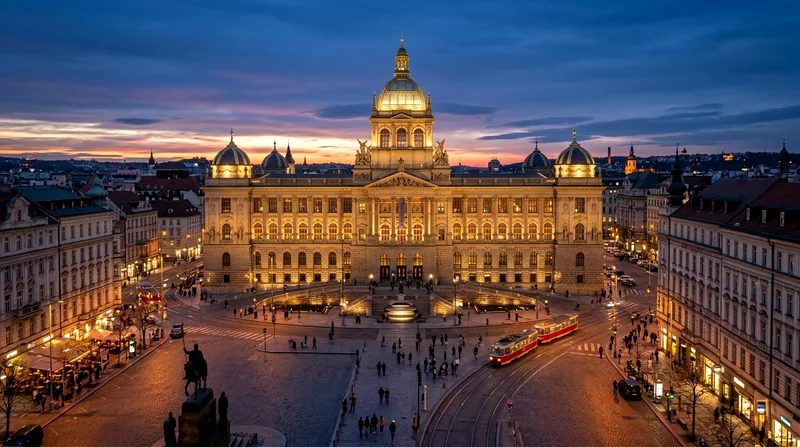
The Prague National Museum sits at the top of Wenceslas Square like a full stop at the end of Prague's busiest boulevard — you can't miss its dome from the metro exit, and that's rather the point. Founded in 1818, it's the oldest and largest museum institution in the Czech Republic, split across several buildings rather than one single collection. That matters for planning: "visiting the National Museum" usually means visiting one specific building, not everything at once.
Most visitors mean the Historical Building when they say National Museum. This is the grand 19th-century structure with the dome, the monumental staircase and the Pantheon hall lined with statues of Czech scientists, artists and statesmen. It reopened in 2018 after a seven-year renovation, and the interior restoration is genuinely the main event — more than the natural history displays inside it.
If you're deciding whether this belongs on a short Prague itinerary, my honest take: go for the building, not the content. The exhibits on minerals, fossils and Czech history are respectable but not exceptional compared to what you'd see in Vienna's Natural History Museum or Munich's Deutsches Museum. What you won't find elsewhere is this specific combination of Czech National Revival architecture crowning Wenceslas Square.
History and the Wenceslas Square Landmark
The museum building was constructed between 1885 and 1891 as a statement piece for Czech national identity, deliberately placed to dominate the square where Czechoslovakia's independence was later declared in 1918 and where the 1989 Velvet Revolution protests gathered. Bullet damage from the 1968 Soviet invasion is still faintly visible on the facade, left unrepaired as a deliberate reminder. Standing in front of it, you're looking at a building that's been a backdrop to most of modern Czech history — that context is worth five minutes even if you skip the ticket entirely.
Who Will Enjoy It Most
Architecture fans, families with kids who like dinosaur bones and mineral cases, and anyone who wants one solid indoor activity near Wenceslas Square will get good value here. Senior travelers should note there's a lift to the main floors, though some side galleries still require stairs. If you're traveling with teenagers who've already done the Prague Castle and Charles Bridge circuit, the Pantheon's statues of Czech cultural figures make a decent change of pace — less crowded, and you can actually sit down.
Which Wings and Exhibitions Are Worth It
Not every gallery inside the National Museum deserves equal time, and being selective is the difference between an enjoyable 75-minute visit and a slow slog through rooms you don't care about. The building is large enough that trying to see everything thoroughly can eat half a day — most people don't need that much.
Historical Building Highlights
The Pantheon is the unmissable room: a domed hall with busts and statues of roughly 50 Czech historical figures, under a ceiling painted with allegorical scenes. The monumental staircase leading up to it, flanked by marble columns, is where most people take their photos — and it photographs better than almost any other interior space in central Prague. Beyond that, the museum holds natural history collections (mineralogy, paleontology, zoology) and a newer permanent exhibition on Czech history across the 20th century, which covers both world wars and the communist period with reasonable depth. I'd prioritize the Pantheon, the staircase, and the 20th-century history exhibition over the mineral rooms unless geology is a specific interest.
New Building and Other Branches
The New Building, just behind the Historical Building and connected by an underground passage, houses temporary exhibitions and a library — it's less essential unless a specific show is on. The National Museum umbrella also includes specialized branches scattered around Prague: the Náprstek Museum of Asian, African and American Cultures near the Old Town, and others focused on music and natural sciences. These are mostly separate tickets and separate trips — don't assume your Historical Building ticket covers them, because generally it doesn't.
How to Visit: Independently or With a Guide
Most people should visit independently. The Historical Building is well signed in English and Czech, the layout is logical once you're past the entrance hall, and there's no complex narrative that requires a guide to follow. A guided tour makes more sense if you want the historical and political context woven in — why the bullet holes are there, what the Pantheon statues represent, how the building ties to 1918 and 1989 — rather than just reading wall text.
Getting There and Planning Your Route
The museum sits directly above Muzeum metro station, served by both the A (green) and C (red) lines — you'll walk out of the station almost directly beneath the building's front steps. From Old Town Square it's a 12 to 15-minute walk down Na Příkopě and up Wenceslas Square, which is a pleasant route in itself. If you're coming from Prague Castle, the tram and metro combination is faster than walking, especially uphill in summer heat. Plan to arrive earlier in the day if you also want to walk the length of Wenceslas Square without heavy foot traffic — by mid-afternoon it's dense with shoppers and tour groups.
National Museum Prague Tickets and Combo Options
Ticket structure here trips people up because the National Museum isn't one ticket, it's several, depending on which building and which temporary exhibitions you want.
The Historical Building ticket covers the Pantheon and main exhibitions, but pairing it with a second museum needs a separate ticket in most cases.
Prague National Museum tickets compared with nearby museum options
| Option | Covers | Typical visit time | Best for |
|---|---|---|---|
| National Museum – Historical Building | Pantheon, staircase, natural history, 20th-century history | 60-90 min | Architecture, history, families |
| National Museum – New Building | Temporary exhibitions only | 30-45 min | Specific current exhibition |
| Prague Museum Pass (seasonal) | Multiple museums over several days | Varies | Multi-museum city trips |
| Museum of Communism | 1948-1989 political history | 45-60 min | Rainy-day pairing, political history |
| National Technical Museum | Transport, industry, hands-on exhibits | 90-120 min | Families, kids, rainy day |
| Museum of Decorative Arts | Design, craft, applied arts | 45-60 min | Quieter alternative, design lovers |
Typical durations and coverage; confirm current ticket categories and combo availability on the official museum site before you go.
Single-Building Versus Combined Entry
A standard National Museum Prague ticket covers the Historical Building's permanent exhibitions — the Pantheon, staircase, natural history halls and 20th-century history displays. There's usually a reduced price for students, seniors and children, and family tickets are often available. A separate, usually cheaper, ticket covers the New Building alone if you only want a temporary exhibition there. Combined tickets covering both buildings exist periodically, and the museum also participates in the Prague Museum Pass in some seasons, which bundles entry to several Prague museums over a set number of days — useful if you're planning three or more museum visits. Because exact ticket categories shift, confirm current combo structures on the museum's official site before planning your day around them.
Where to Buy and What to Check Before You Go
Buying online in advance through the museum's official ticketing page avoids the ticket-counter queue, which can run 15 to 20 minutes on weekends and during school holidays. Check three things before you go: current opening hours (the museum closes one day a week, which varies by season), whether your date falls on a free-entry day — some Czech museums offer these on the first Sunday of certain months — and whether any gallery is temporarily closed for conservation work, which happens periodically in such a large building. If you're bundling this with other Prague sights, compare current prices and combo options when you book, since bundled city-pass pricing changes more often than single-museum tickets.
Best Time to Visit and Rainy-Day Pairings
Timing your visit well matters more here than at smaller Prague museums, because the Pantheon and staircase are genuinely crowded with tour groups by late morning in peak season (roughly May through September).
Quieter Times and Seasonal Tips
Arrive at opening or within the first hour for the clearest photos of the staircase and Pantheon without other visitors in frame. Winter weekday mornings are noticeably quiet — you might have entire galleries to yourself. Avoid early afternoon on weekends year-round, when both tour groups and local families cluster here, especially if it's raining and everyone's indoor-sightseeing plan converges on the same few buildings.
Other Prague Museums That Pair Well
For a rainy day, pair the National Museum with something different in tone rather than another history-heavy stop. The Museum of Communism, a short walk away near Wenceslas Square, gives a more pointed, narrative-driven take on the 1948–1989 period that complements the National Museum's broader historical exhibition. Families with kids who liked the natural history rooms often do well at the National Technical Museum in Holešovice, which is hands-on with vintage cars, planes and a mine tunnel exhibit — more engaging for under-12s than another hall of static displays. If your interests lean toward design and craft rather than politics, the Museum of Decorative Arts near the Old Town is smaller and calmer, a good counterpoint after a crowded morning. Music fans might prefer the Czech Museum of Music over a second large institution. Compared with a full day in Kutna Hora or a Cesky Krumlov day trip, these in-city pairings let you build a complete rainy day without leaving Prague at all.
Frequently asked questions
Is the Prague National Museum worth visiting?
Yes, mainly for the building itself — the restored Pantheon and monumental staircase in the Historical Building are worth 60-90 minutes even if natural history exhibits aren't your main interest. If you only have time for one Prague museum and want interactive or narrative-driven content, the Museum of Communism or National Technical Museum may satisfy you more than the exhibits here.
How long do you need at the National Museum in Prague?
Budget 60-90 minutes for the Historical Building, including the Pantheon, staircase and main historical exhibition. Add 30-45 minutes if a temporary exhibition in the New Building interests you. Museum enthusiasts who want to read every panel in the 20th-century history section could stretch this to two hours.
Can you buy National Museum Prague tickets online?
Yes, tickets are sold through the museum's official website, and buying ahead avoids counter queues that can run 15-20 minutes on weekends or school holidays. Confirm current ticket categories, reduced-price eligibility and any free-entry days directly on the official site before your visit.
Is there a combo ticket for the Prague National Museum?
There are periodic combined tickets covering both the Historical and New Buildings, and the museum sometimes participates in the Prague Museum Pass alongside other city museums. Availability and inclusions shift, so check the official ticketing page for current combo options before assuming one applies to your visit.
Which Prague museums are best on a rainy day?
Pair the National Museum with the Museum of Communism for political history, the National Technical Museum for families and hands-on exhibits, or the Museum of Decorative Arts for a quieter, design-focused stop. All three sit within a reasonable metro or tram ride of Wenceslas Square, making a full indoor day realistic without a taxi.