Compare Prague nuclear bunker tours, from vintage-vehicle trips to guided shelters. See what to expect underground, claustrophobia tips and age guidance.
Prague Nuclear Bunker Tour: Cold War Underground Guide
Step beneath Prague into a fallout shelter built for a war that never came, and you get a different kind of sightseeing than Old Town Square offers. A Prague nuclear bunker tour usually means descending into a civil defence shelter constructed under Communist Czechoslovakia, often arriving in a restored Eastern Bloc vehicle — a Trabant, a Soviet-era van, sometimes a military truck — that's as much a photo opportunity as transport. These shelters were part of a Warsaw Pact-wide civil defence network, built to house officials, workers, or local residents in the event of nuclear conflict with NATO. Some sit directly under Prague's streets and apartment blocks; others are larger complexes repurposed since the Velvet Revolution for tourism rather than survival. The format varies more than people expect, and picking the wrong one means either overpaying for a gimmick or missing the vehicle ride that makes the whole thing memorable.
Who Each Bunker Tour Suits
Not every traveler gets the same value from a few hours underground. Some people find damp concrete corridors and Cold War gas masks fascinating; others find them merely cold and dim. Knowing which camp you're in before booking saves money and disappointment.
History fans and Cold War curious travelers
If you've already done the Museum of Communism or you're curious about daily life in Communist Czechoslovakia beyond the postcard version of Prague, a bunker tour adds texture the main sights don't. Guides typically cover civil defence planning, how ordinary citizens were (or weren't) prepared for nuclear war, and what the Warsaw Pact's standoff with NATO actually meant for a city like Prague. Expect original 1950s-80s equipment — Geiger counters, gas masks, hand-cranked air filtration units — rather than reconstructions. This group should prioritize tours with a dedicated guide over self-paced ones; the context is the whole point, and without it you're just looking at pipes and bunk beds.
Families and older visitors
Families with teenagers tend to do well here — there's enough genuine strangeness (blast doors, decontamination showers, propaganda posters) to hold a 13-year-old's attention longer than another church interior would. Younger children often struggle with the dark, the cold, and the walking. Older visitors generally handle the tours fine if mobility is reasonable, but steep metal stairs and low ceilings are common, and there's rarely a lift. If anyone in your group uses a cane or has knee problems, ask directly about stair count and handrails before booking rather than finding out underground.
Main Prague Bunker Tour Types Compared
Broadly, Prague bunker tours split into two formats, and then a separate question of group size on top of that. Picking the format first narrows things down fast.
Vintage-vehicle combo tours trade bunker depth for novelty, while standalone and private tours give more time underground with fewer crowds.
Prague nuclear bunker tour types compared by duration, format and who they suit
| Tour Type | Typical Duration | What's Included | Best For | Watch Out For |
|---|---|---|---|---|
| Vintage-vehicle combo | 2-3 hours | Short city drive plus bunker visit | Novelty seekers, first-time visitors | Shorter time underground |
| Standalone group bunker tour | 60-90 minutes | Guided shelter visit, shared pace | Budget-conscious history fans | Crowded corridors, fixed pace |
| Private bunker tour | 60-90 minutes, flexible | Guided shelter visit, personalized pace | Families, those with mobility needs, detailed questions | Higher cost than group option |
Durations and inclusions are typical ranges; always confirm exact format and pacing when booking.
Vintage-vehicle tours with bunker visit
These combine a short driving tour of Prague — often in a Trabant, a Czechoslovak-made car that's become a Cold War tourism staple — with a stop at a shelter. You get street-level Prague (sometimes past landmarks tied to the 1989 Velvet Revolution) plus the underground portion, usually totaling two to three hours. The upside is variety: it doesn't feel like just a basement tour. The downside is that the bunker portion is often shorter than on a standalone tour, since time is split with driving. If the vehicle ride is a novelty you specifically want, this is the better pick; if you want to really sit with the history, it can feel rushed.
Standalone bunker visits and private vs group
A standalone bunker tour skips the vehicle gimmick and goes straight underground, typically running 60 to 90 minutes with more time spent on explanation and original equipment. This suits travelers who've already seen Prague's surface-level sights and want depth over novelty. On group size: standard group tours keep costs down but move at a fixed pace and can feel crowded in narrow corridors — not ideal if you dislike waiting behind other people in a tight stairwell. Private tours cost more but let you set the pace, ask more questions, and avoid bottlenecks, which matters more here than on, say, a walking tour of Prague Castle, simply because bunker spaces are physically tighter.
What to Expect Underground
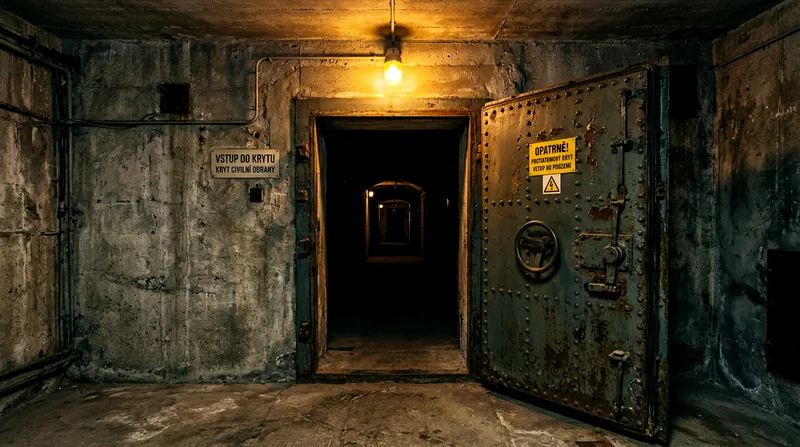
Physically, these shelters are concrete, low-lit, and noticeably colder than the street above — often by several degrees even in summer. Expect narrow corridors, heavy steel blast doors that still operate, bunk-style sleeping quarters, hand-operated air filtration systems, and glass cases of Cold War-era gear: gas masks, ration tins, radiation detection equipment. Some bunkers retain original paint and signage from the Communist Czechoslovakia period, which is more atmospheric than anything reconstructed for tourists. Lighting is usually dim and sometimes just bare bulbs, which adds to the mood but doesn't suit anyone who needs good visibility to move safely.
Claustrophobia, temperature and accessibility
Be honest with yourself here. Corridors are often under two meters wide, ceilings can be low enough that taller visitors duck, and there's generally one route in and one route out — not a lot of room to step aside if you need a moment. If you're prone to claustrophobia, ask in advance how deep the bunker sits and whether the tour allows you to wait near an exit rather than complete the full loop. Bring a layer even in August; underground temperatures commonly sit in the low-to-mid teens Celsius regardless of the season. Wheelchair access is poor to nonexistent at most sites — steep stairs are standard, and there's rarely a ramp or lift alternative.
Age guidance for children
Most operators suggest a minimum age around 6 to 8, though the real limiting factor is attention span and tolerance for dark, enclosed spaces rather than a hard rule. A nervous 10-year-old will struggle more than a curious 6-year-old. If you're traveling with young kids, ask specifically whether strollers are allowed (usually not, given the stairs) and whether the tour can be shortened. For strict comparison, this is a very different experience from the Prague Zoo or a boat trip on the Vltava — it's indoors, dim, and not designed around children's comfort.
What to Check Before Booking
Treat a bunker tour booking with a bit more scrutiny than a standard Prague walking tour, because the physical constraints are less forgiving if something doesn't match expectations.
Inclusions, group size and cancellation
Confirm whether transport to the meeting point is included or whether you're expected to reach Prague Old Town or another central spot yourself — most tours meet centrally for easy access by metro or tram. Check group size caps; anything over 15 people in a bunker setting usually means long waits in corridors rather than meaningful time with the guide. Look at the cancellation policy closely, since bunker tours run rain or shine (being underground, weather barely matters) but can be canceled by the operator if minimum numbers aren't met, particularly off-season. Read recent reviews specifically for mentions of guide language quality, since some tours run primarily in Czech with English support rather than fully bilingual narration. Always compare current prices and reviews for a few options before you commit — availability and exact inclusions shift more than people expect for a niche tour like this.
When to Book Your Bunker Tour
Bunker tours run year-round since they're indoors, which makes them a smart rainy-day or winter booking when outdoor options like a Vltava river cruise or a day trip to Cesky Krumlov lose their appeal. That said, popular time slots — especially weekend afternoons and small private tours — can sell out a few days ahead in peak season (roughly May through September), so booking 3-5 days in advance is reasonable rather than leaving it to the morning of. Compare this to a day trip to Kutna Hora or Dresden: those are weather-dependent and worth booking further out for transport reasons, while a bunker tour's main booking risk is just slot availability, not conditions. If your schedule is tight, slot a bunker tour in as a half-day activity rather than stacking it with Prague Castle or a Charles Bridge walk on the same morning — the contrast between bright daylight sightseeing and a cold, dim shelter is better appreciated when you're not rushing between the two.
Frequently asked questions
Is the Prague nuclear bunker tour suitable for children?
Generally yes from around age 6-8, but it depends on the child. Dark corridors, cold temperatures, and steep stairs are more limiting than any strict age rule. Strollers typically aren't usable underground, and younger children often get bored or unsettled faster than adults expect. If traveling with a sensitive child, ask the operator whether the route can be shortened.
Is the bunker tour a good choice if I am claustrophobic?
Approach with caution. Corridors are narrow, ceilings are low in places, and there's usually only one way in and out. If you have mild claustrophobia, ask in advance about the bunker's depth and whether you can step toward an exit if needed. If it's severe, a standalone bunker tour is probably not worth the risk — consider an above-ground Cold War museum instead.
How long does a Prague Cold War bunker tour take?
Standalone bunker visits typically run 60 to 90 minutes. Vintage-vehicle combo tours that include a city drive plus a bunker stop usually run 2 to 3 hours total, with less time actually spent underground. Private tours can sometimes run longer since pacing is flexible rather than fixed to a group schedule.
Is a private or group bunker tour better in Prague?
Group tours cost less and work fine if you're comfortable waiting your turn in tight spaces. Private tours cost more but let you move at your own pace, ask more detailed questions, and avoid corridor bottlenecks — which matters more here than on open-air tours, simply because bunker spaces are physically confined.
What should I wear for a Prague bunker tour?
Bring a layer regardless of season — underground temperatures commonly sit in the low-to-mid teens Celsius year-round. Wear flat, closed-toe shoes for steep metal stairs and uneven concrete floors, and skip anything you'd mind getting slightly dusty, since original Cold War-era surfaces aren't polished for tourists.