The Prague bone church is actually in Kutna Hora. Learn how to get there, compare combo tickets and tours with St Barbara's Cathedral, and plan your day.
Is the Bone Church in Prague?
Short answer: no. The chapel everyone calls the "Prague bone church" sits in Kutna Hora, a town roughly 70 kilometers east of the capital, not within Prague's city limits. Its real name is the Sedlec Ossuary, part of the Cathedral of the Assumption of Our Lady at Sedlec complex, and it gets lumped in with Prague simply because almost everyone who visits is staying there and treats it as a day trip.
That mix-up causes real planning mistakes. People search for walking directions from Old Town, assume it's a tram ride away, and only discover the truth once they're already booking. It isn't a quick detour between Prague Castle and the Charles Bridge — it requires leaving the city for the better part of a day.
I'd rather travelers know this upfront than find out mid-itinerary. If you've got one day in Prague and you're trying to squeeze in the ossuary along with the castle and the Astronomical Clock, something has to give. This is a separate excursion, closer in scope to a trip to Český Krumlov or Dresden than to anything inside Prague proper.
Kutna Hora vs Prague location
Kutna Hora is a standalone UNESCO World Heritage Site in its own right, recognized mainly for its medieval silver-mining wealth and the Gothic St Barbara's Cathedral it funded. The Sedlec Ossuary sits on the edge of town, about a 10-15 minute walk from the main train station and roughly 2 kilometers from the historic center where St Barbara's stands. So even within Kutna Hora, you're covering two separate pockets of town, not one compact site.
Why it's worth the trip
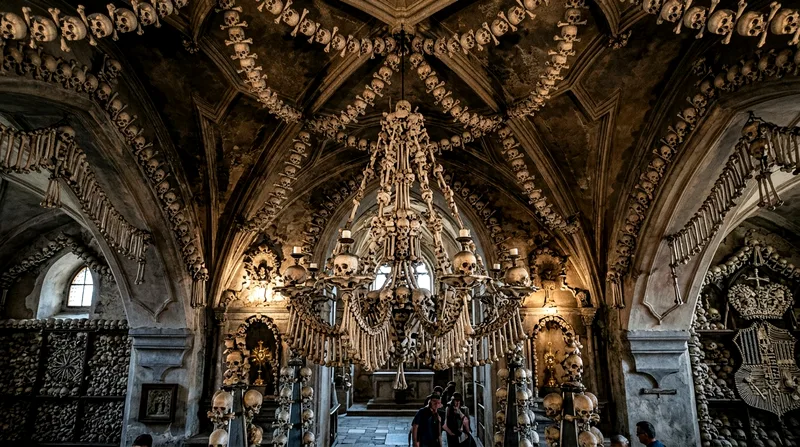
The ossuary holds the bones of an estimated 40,000 to 70,000 people, arranged into chandeliers, garlands, a coat of arms, and chalice-shaped pyramids by woodcarver František Rint in the 1870s. Nothing else in the Czech Republic looks like it, and few sites in Europe combine this level of craftsmanship with this level of unease. Compared with a Budapest thermal bath or a Vienna palace, it's a different kind of memorable — the sort of place you describe to people back home and watch their faces change.
What You'll See at Sedlec Ossuary
The chapel's history starts with dirt, literally. In the 13th century, an abbot of the Cistercian Order brought back soil from Golgotha in Jerusalem and scattered it over the Sedlec Abbey cemetery, which instantly made it one of the most desirable burial spots in Central Europe. Plague in the mid-14th century and the Hussite Wars in the early 15th century filled the cemetery many times over, and by the time a half-blind monk began stacking the excess bones in the early 1500s, there were simply too many skeletons to bury conventionally.
Rint's 19th-century redesign is what visitors see today: four bone mounds in the corners, a coat of arms of the Schwarzenberg family picked out in bone (including a raven pecking at a skull), and a central chandelier said to contain at least one of every bone in the human body. It's a small single-nave chapel — you can walk the whole interior loop in under 15 minutes — but the detail rewards slow looking rather than a quick lap.
Photography is generally allowed inside, often for a small separate fee or included with entry depending on current rules, so check signage or your ticket terms on arrival. Don't expect a hushed, empty space either — this is one of the most visited sites in the Czech Republic outside Prague, and midday tour groups can fill the small chapel quickly. I'd treat it as a 20-30 minute stop including the walk around outside, not a lingering, contemplative hour.
Getting from Prague to Kutna Hora
There are two realistic ways to do this trip: independent train travel, or a guided tour that handles transport and timing for you. Both work well; which suits you depends on how much you want to plan versus how much you want explained.
The train is cheaper and more flexible, while a guided tour trades cost for convenience and context.
Prague to Kutna Hora: comparing ways to see the bone church
| Option | Travel Time | Cost Level | Flexibility | Best For |
|---|---|---|---|---|
| Direct/connecting train | approx. 50-70 min each way | Low | High — your own schedule | Budget travelers, independent planners |
| Guided day tour (coach) | approx. 2.5-4 hrs round trip incl. stops | Higher | Low — fixed itinerary | Families, first-timers, those wanting a guide |
| Self-drive/rental car | approx. 1 hr each way | Medium (fuel, parking) | High | Travelers combining multiple towns |
| Train + local bus/taxi in town | approx. 60-90 min total | Low-Medium | Medium | Visitors doing both ossuary and old town |
Typical figures; exact train times and tour durations vary by season and provider, so check current schedules before you travel.
Independent trip by train
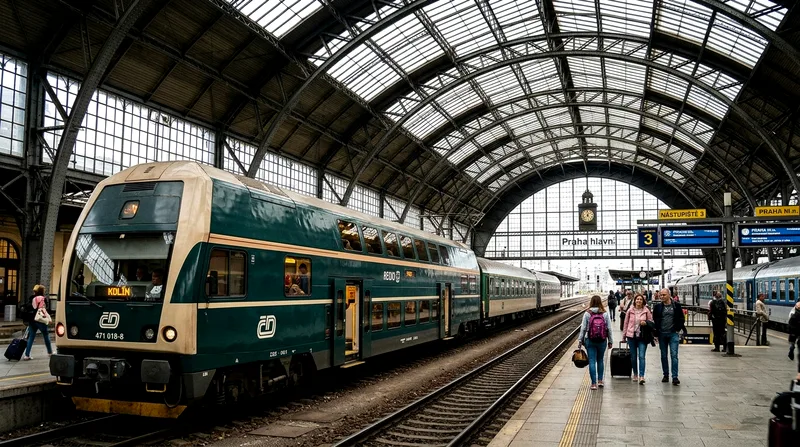
Czech Railways (České dráhy) runs regular direct and connecting trains from Prague Main Railway Station (Praha hlavní nádraží) to Kutna Hora, with the journey taking roughly 50 minutes to just over an hour depending on the service. You'll arrive at Kutna Hora hlavní nádraží, which is actually closer to the Sedlec Ossuary than to the old town center — a reasonably flat 10-15 minute walk gets you there, so you can see the ossuary first and work your way into town afterward.
Tickets are inexpensive by Western European standards and can be bought at the station, via ticket machines, or through the Czech Railways app, which also shows live schedules. Buy on the day; advance booking isn't necessary for this route. The catch: local buses or a short walk are needed to get from the Sedlec station area into Kutna Hora's historic core for St Barbara's, so budget extra time if you're doing both on foot. This is the cheapest option and gives you full control over your schedule, but it also means you're your own tour guide — there's no posted signage inside the ossuary explaining much beyond the basics.
Guided tour from Prague
Guided day tours typically bundle round-trip transport (usually by coach, sometimes with a train leg), skip-the-line or pre-booked entry, a guide who covers the history in detail, and a stop at St Barbara's Cathedral and sometimes the old town. These run longer than the train — often a half-day to full-day commitment — but remove all the logistics: no station navigation, no working out bus connections, no standing in a ticket queue at the ossuary.
The trade-off is cost and flexibility. You'll pay noticeably more than the train fare, and you move on the group's schedule, not yours. For solo travelers or couples who want background context without researching it themselves, or for families managing kids on a tight day, a tour removes friction. For budget-focused travelers or anyone who prefers wandering at their own pace, the train is the better call. Compare current tours and prices before you book — options and inclusions vary by season and operator.
Sedlec Ossuary Tickets and Combo Options
Sedlec Ossuary tickets are sold on-site and, increasingly, online in advance — worth doing if you're visiting during a busy midday slot or peak season, since it cuts queueing. Entry is managed separately from St Barbara's Cathedral, since the two sites belong to different administrations within Kutna Hora, which is part of why combo tickets exist as a convenience rather than a single unified pass.
Standalone entry
A basic ticket gets you into the ossuary chapel only, with typical visit time of 20-30 minutes. This suits travelers short on time or those primarily drawn by the ossuary itself rather than Kutna Hora's wider Gothic architecture. It's the cheapest way in, and reasonable if you're treating this as one stop among several on a packed itinerary — though I'd still argue you're underusing the trip if you stop here.
Combo tickets with St Barbara's
Combined tickets covering the ossuary and St Barbara's Cathedral (sometimes with the Italian Court or other Kutna Hora sites added) generally cost somewhat more than ossuary-only entry but less than buying both separately. Given that you've already traveled an hour from Prague, the marginal cost of adding the cathedral is usually small relative to the transport time already spent. I'd recommend the combo for nearly everyone making this trip — skipping St Barbara's after coming this far feels like visiting Vienna and skipping Schönbrunn. Check official Kutna Hora tourism or GASK (the regional gallery managing some sites) channels for current combo options and prices, since bundling details change periodically.
Best Time to Visit the Bone Church
Opening hours shift seasonally — typically longer hours through the warmer months and a shorter, sometimes midday-closed schedule in winter — so always check the current timetable before heading out, especially if traveling between November and March. Arriving right at opening, generally mid-morning, is the best way to beat the tour buses that start rolling in from Prague by late morning.
Weekday visits are noticeably calmer than weekends, and shoulder-season months (April-May, September-October) offer a reasonable trade of decent weather and thinner crowds compared with the peak July-August stretch, when the small chapel can feel genuinely crowded. Winter has its own appeal — fewer visitors, a starker atmosphere fitting the subject matter — but you'll want to confirm the site isn't on reduced hours or closed for any maintenance period, which does happen periodically.
One thing I don't love: there's limited space inside, and on a packed summer afternoon, you're often shuffling past the chandelier rather than studying it. If atmosphere matters more to you than convenience, aim for an early slot or a shoulder-season weekday. If you're simply ticking it off during a tight Prague stay, any time works — you'll still see everything in the one small room.
Add-Ons: St Barbara's and Old Town
Treating Kutna Hora as a one-attraction stop undersells it. The town earned its UNESCO status on the back of silver mining wealth that built far more than one chapel, and most of that is walkable from the historic center.
St Barbara's Cathedral
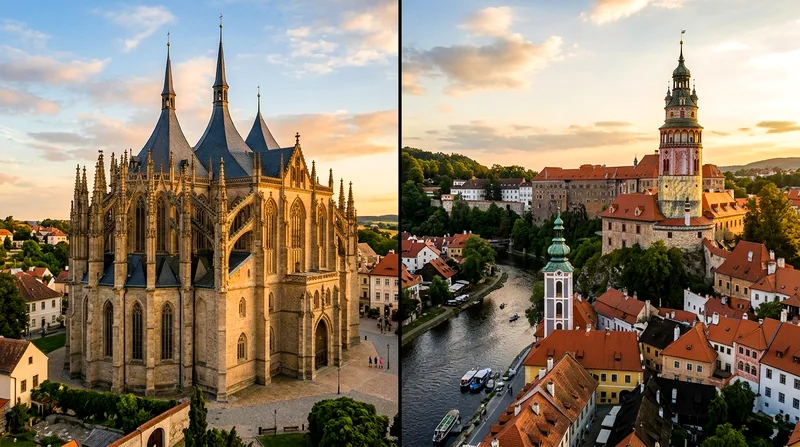
St Barbara's Cathedral is arguably the better architectural experience of the two sites — a soaring Gothic church with flying buttresses, tent-like ribbed vaulting, and medieval frescoes depicting mining and minting, a nod to the silver trade that funded it. It sits on a hillside above the Vrchlice river valley, roughly a 20-25 minute walk from the ossuary through the old town. Compared with Prague's St Vitus Cathedral, it's smaller and far less crowded, which actually makes it easier to appreciate the details. Budget 30-45 minutes inside.
Other Kutna Hora sights
The Italian Court (Vlašský dvůr), once a royal mint and residence, offers tours into the old coin-minting operations and is a reasonable stop if you have an extra hour. The Czech Museum of Silver digs deeper into the mining history that built the town, including a tour into original medieval mine shafts — a solid option for families with older kids who want something more hands-on than another church interior. Realistically, Kutna Hora rewards a half-day minimum beyond the ossuary; trying to also fit in Český Krumlov or Dresden on the same day isn't feasible given the distances involved.
Frequently asked questions
Is the bone church in Prague or Kutna Hora?
It's in Kutna Hora, not Prague. The Sedlec Ossuary sits about 70 kilometers east of the capital, within its own UNESCO-listed historic town. People call it the "Prague bone church" because it's almost always visited as a day trip from Prague, but it isn't inside the city.
How do I get from Prague to the Sedlec Ossuary?
The simplest way is a direct or connecting Czech Railways train from Prague Main Railway Station, taking roughly 50 minutes to just over an hour, followed by a 10-15 minute walk from Kutna Hora's station. Guided tours from Prague also run, typically combining coach transport with entry tickets and a stop at St Barbara's Cathedral.
Is a combo ticket with St Barbara's Cathedral worth it?
Yes, for most visitors. The extra cost over an ossuary-only ticket is usually modest, and since you've already made the trip from Prague, seeing St Barbara's — widely considered Kutna Hora's architectural highlight — makes the day feel far more complete.
How long do you need at the bone church?
The chapel itself takes about 20-30 minutes to see properly, since it's a single small room. Budget extra time for the walk from the train station and, if you're adding St Barbara's or the old town, plan for a half-day in Kutna Hora overall.
Can you visit the bone church on a day trip from Prague?
Yes, easily. With an early train out and a mid-afternoon return, you can comfortably see the ossuary, walk into Kutna Hora's old town, and tour St Barbara's Cathedral in a single day, typically returning to Prague by early evening.