Compare Prague communism tours covering the Prague Spring 1968, the Velvet Revolution and daily life under communism, plus the museum ticket worth adding.
Which Communism Tour Suits You
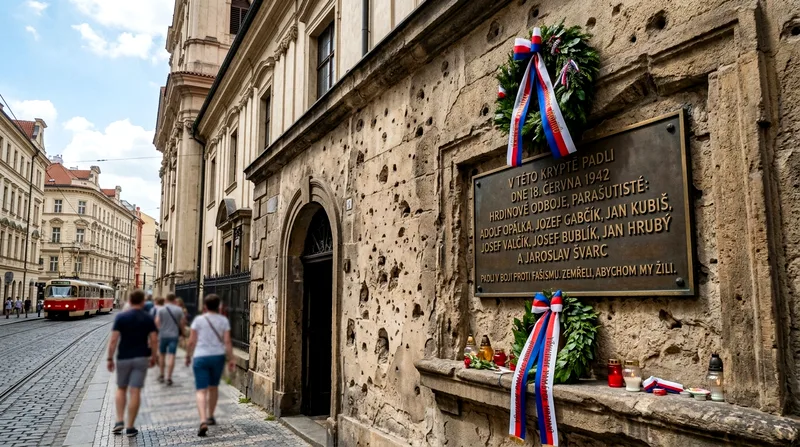
Prague carries its 20th-century history openly — bullet-scarred walls, a former secret police headquarters, a square where two uprisings happened 21 years apart. A Prague communism tour works through this layer of the city in a way that a general Old Town walk never will, because the guides specialize in it rather than squeezing it between astronomical clock photos. If you're deciding whether to book one at all, the honest answer is: book one if you actually want to understand what happened between 1948 and 1989, not just see the buildings.
The subject rewards some preparation. You'll get far more from a guide's explanation of the 1968 invasion if you already know roughly who Alexander Dubček was and why "socialism with a human face" alarmed Moscow. You don't need to read a book beforehand — a decent guide explains the background as they go — but a tour that assumes zero context tends to simplify Czechoslovakia's communist period into a vague "it was bad" narrative, which undersells a genuinely complicated 41 years.
History buffs and first-time visitors
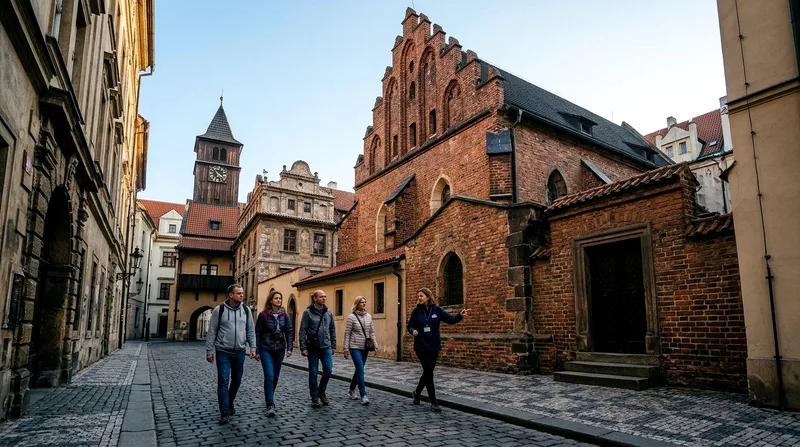
If you already know the broad strokes of the Cold War, look for a small-group or private walking tour that spends real time on specifics — the 1968 Soviet invasion, the Charter 77 dissident movement, the StB secret police apparatus. These tours typically run 2 to 3 hours and move at a pace that allows for genuine Q&A. First-time visitors to Prague with no prior background still do fine on a standard group walking tour, but should expect a more introductory framing: who the Warsaw Pact was, why Czechoslovakia split from Austria-Hungary in 1918, then fell under Soviet influence after 1948. Ask in advance, if booking private, whether the guide can go deeper into 1968 specifically — not every guide weights the tour the same way.
Families and short-stay travelers
Communism tours are not built for young children. The content covers surveillance, imprisonment, and political violence, and most guides pitch their commentary at adults. Families with teenagers who've studied 20th-century history in school tend to get genuine value out of it — the StB prison stories and Cold War espionage angle land well with that age group. For a short Prague stay of two or three days, a 2-hour walking tour that covers Wenceslas Square, Old Town sites, and finishes near the National Museum is the efficient choice — it leaves the rest of your day free for the castle or a river cruise.
Main Types of Communism Tours Compared
Prague's communism-themed tours split into a few recognizable formats, and the differences matter more than they first appear. Walking tours dominate the market because most of the relevant sites — Wenceslas Square, the former Radio Free Europe building, Old Town StB sites — sit within a compact, walkable core. Vehicle-based tours exist mainly to reach Letná Park efficiently or to combine communism history with a wider half-day Prague overview.
Group size is the other major variable. A standard small-group tour (often capped around 10-15 people) costs less per person and still allows reasonable interaction with the guide. Private tours cost more but let you set the pace, skip sections you already know, and push deeper into topics like the 1968 invasion or Havel's path to the presidency. Neither format is objectively better — it depends on budget and how much control you want over the content.
Walking tours offer the most depth per hour, while vehicle tours trade some intimacy for reaching sites like Letná Park efficiently.
Prague communism tour formats compared by duration, depth and best fit
| Tour Format | Typical Duration | Group Size | Best For |
|---|---|---|---|
| Standard group walking tour | 2-3 hours | Small group (shared) | First-time visitors, solo travelers, couples |
| Private walking tour | 2-3 hours, flexible | Just your party | History buffs, families with teens, slower pace needs |
| Vehicle or hybrid tour | 2.5-4 hours | Small group or private | Reaching Letná Park, combining with wider city overview |
| Museum of Communism visit (self-guided) | 45-90 minutes | Individual | Pairing with any tour format, rainy days |
Durations and group sizes are typical ranges; check current tour listings for exact format and current prices before booking.
Walking vs vehicle-based tours
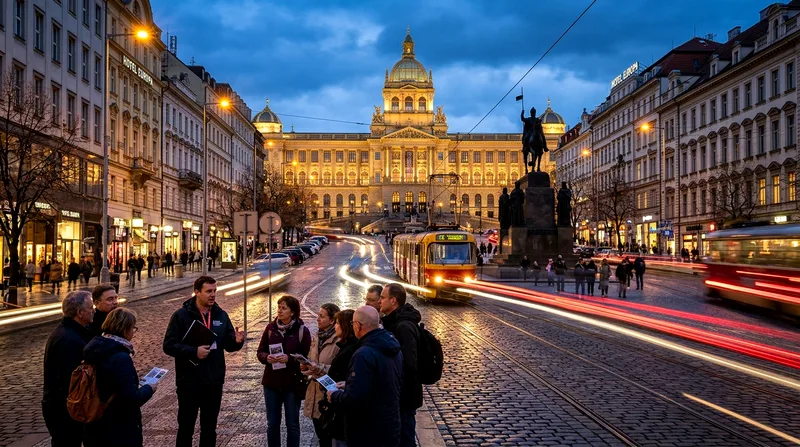
Walking tours are the default for good reason: Wenceslas Square, the Old Town StB sites, and several Velvet Revolution locations sit within 15-20 minutes of each other on foot, so you're not wasting time in transit. Expect a route of roughly 2 to 3 kilometers over 2-3 hours, with some standing-still time while the guide explains events at each stop. The drawback is weather — Prague winters make a 2-hour outdoor walk genuinely uncomfortable, and summer heat on open squares like Wenceslas Square isn't pleasant either.
Vehicle-based or hybrid tours (sometimes using an Eastern Bloc-era car like a Trabant or Škoda as a novelty element) solve the Letná Park problem — it's a steep uphill walk from the river and easy to skip on foot. These tours can also bolt on sites further from the center. The trade-off is less intimate storytelling; you spend part of the tour in transit rather than standing where things actually happened.
Private vs small group
Small group tours are the sensible default for solo travelers and couples on a budget — you still get a live guide and real interaction, just shared with a handful of other travelers. Private communism tours in Prague suit families who want to control pacing, history buffs who want to spend 20 minutes on one topic instead of two minutes, and anyone traveling with an older relative who needs a slower walking speed or more frequent breaks. The flexibility comes at a real price premium, so weigh it against how much a single afternoon's customization is actually worth to you.
Themes Tours Cover: 1968 to 1989
A genuinely useful Prague communism tour doesn't treat 1948 to 1989 as one flat story — the texture changes a lot across four decades. Most itineraries anchor on two turning points: the 1968 Prague Spring and its crushing by Warsaw Pact tanks, and the 1989 Velvet Revolution that ended one-party rule. Between those two events sits two decades of "normalization" — quieter, grimmer, less dramatic, but arguably more revealing of how daily life actually worked under the regime.
Good guides connect the physical city to the politics: Wenceslas Square as the stage for both 1968 protests and the 1989 demonstrations, Letná Park as the site of a vast Stalin monument (demolished in 1962) and later a 1989 protest gathering point, and specific buildings tied to the secret police or state radio. If a tour only talks about buildings and never names the political events behind them, you're getting architecture history dressed up as Cold War history.
Prague Spring 1968 and the Soviet invasion
The Prague Spring refers to a period of political liberalization led by Alexander Dubček starting in January 1968 — loosened censorship, moves toward multi-party structures, what Dubček called "socialism with a human face." It ended abruptly on the night of August 20-21, 1968, when Warsaw Pact troops, led by the Soviet Union, invaded Czechoslovakia. Tours covering this period typically walk you past Wenceslas Square, where some of the resistance and self-immolations (including Jan Palach's death in January 1969) took place, and explain how the invasion led directly into the harsher "normalization" era under Gustáv Husák. This is usually the densest, most historically specific part of a communism tour — expect 20-30 minutes of focused narrative if the guide treats it properly.
Velvet Revolution and everyday life
The Velvet Revolution in November 1989 gets its name from how quickly and peacefully the communist government fell — mass demonstrations starting November 17, centered on Wenceslas Square, led within weeks to Václav Havel's election as president. A velvet revolution tour of Prague typically traces the student march route, the balcony scenes on Wenceslas Square, and Havel's own path from dissident playwright to head of state. Equally valuable — and often shorter-changed — is the "everyday life" material: ration systems, travel restrictions, surveillance by the StB, the gray consumer goods shortage that defined the 1970s-80s. Ask whether a tour covers this daily-life angle; some focus almost entirely on the two dramatic bookends and skip the two decades in between.
Adding the Museum of Communism Ticket
The Museum of Communism, located near Wenceslas Square, is the natural companion to any walking tour on this subject. It houses period objects — propaganda posters, a reconstructed interrogation room, consumer goods from state shops, school classroom displays — that give physical weight to what a guide describes verbally outdoors. A visit typically takes 45 to 90 minutes depending on how closely you read the exhibit text, which is dense but well-organized chronologically from the 1948 coup through 1989.
Is the Museum of Communism worth visiting on its own, without a tour? Yes, reasonably — the exhibits are self-explanatory with English captions throughout. But it works better as a complement than a substitute. A walking tour gives you the geography and the human stories tied to specific streets; the museum gives you the objects and documents. Doing both in one day is common and not excessive — plan for roughly half a day total between the two.
Tour first, museum second
The better sequence, in most cases, is tour first, then museum. A guide's live narrative primes you to recognize objects in the museum — a ration card, a Collective Farm poster, a StB surveillance photo — that would otherwise be just another display case. Doing it in reverse order works too, but you lose some of that recognition effect. If your schedule only allows one visit per day, book the walking tour for morning (cooler, less crowded on Wenceslas Square) and the museum for early afternoon.
Who can skip the museum
If you're short on time — say, a single day in Prague before moving on to Český Krumlov or Dresden — a well-run 2-3 hour walking tour alone gives you a coherent, complete story without the museum. Visitors who've already toured similar Cold War museums elsewhere (Berlin's DDR Museum, for instance) may find some overlap in theme, though Prague's museum focuses specifically on Czechoslovak experience rather than East Germany's. Travelers tight on budget can reasonably treat the museum as optional rather than essential.
What to Check Before Booking
Not all communism tours in Prague are run with the same rigor, and the quality gap between a well-prepared guide and a generalist reading from notes is noticeable. Before booking, look past the marketing description and check a few specifics that actually predict whether you'll get your time and money's worth.
Inclusions, group size and guide expertise
Check whether the listed price includes museum entry, transport between sites, or just the guide's time — these vary a lot between listings and change the effective value. Confirm the group size cap; a tour advertised as "small group" that actually runs 25 people isn't small. Look for guides described as historians, former residents of communist-era Czechoslovakia, or specialists in 20th-century Central European history — generic "licensed city guides" can still be good, but subject specialists tend to answer follow-up questions with more precision, especially on nuanced topics like why the 1968 reforms specifically alarmed the Soviet leadership.
Cancellation and accessibility
Outdoor walking tours are weather-dependent, so check the cancellation policy before paying — free cancellation up to 24 hours ahead is standard on most reputable booking platforms, but not universal. If you're traveling with a senior relative or anyone with mobility limitations, ask specifically about cobblestones (common throughout Old Town and Wenceslas Square) and whether Letná Park's uphill section is included, since that stretch has no easy step-free shortcut. Always compare current prices and recent reviews on your booking platform before confirming — availability and guide assignment can shift seasonally.
When to Book Your Tour
Communism tours don't sell out the way a Prague Castle skip-the-line ticket does, but booking a few days ahead is still sensible, especially for private tours where you need the guide's calendar to align with yours. Spring and early autumn are the most comfortable seasons for the outdoor walking portions — summer heat on open squares like Wenceslas Square can be draining by midday, and winter tours require real cold-weather clothing since you'll be standing still outdoors for stretches while the guide talks.
If you're combining Prague with a wider Central European trip — Vienna for its imperial history, Budapest for its own 1956 uprising story, or Kraków with Auschwitz nearby — it's worth sequencing the Prague communism tour early in your itinerary. It gives useful context for Budapest's own communist-era sites and makes comparisons between the two countries' very different paths to 1989 more meaningful. Compare current tour listings, group sizes, and reviews on your booking platform a few days before your date, and confirm the museum's opening hours separately if you're adding that ticket on.
Frequently asked questions
Is a Prague communism tour worth it?
Yes, for most visitors with genuine interest in 20th-century history — it's one of the few subjects in Prague where a knowledgeable guide adds real value over wandering on your own, since the relevant sites (StB buildings, protest locations) aren't well marked. Skip it if you only have a few hours in the city and prioritize the castle or Charles Bridge instead.
How long does a communism tour in Prague take?
Most walking tours run 2 to 3 hours, covering roughly 2-3 kilometers through Wenceslas Square, Old Town and nearby sites. Vehicle or hybrid tours that include Letná Park typically run 2.5 to 4 hours. Add 45-90 minutes if you're pairing the tour with a Museum of Communism visit.
Is the Museum of Communism worth visiting after a tour?
Yes — it reinforces what a guide describes verbally with actual period objects, propaganda posters and a reconstructed interrogation room. It's well captioned in English and works as a stand-alone visit too, but pairs best as a follow-up to a walking tour rather than a replacement for one.
What happened during the Prague Spring in 1968?
Alexander Dubček led a period of political liberalization in Czechoslovakia starting January 1968, loosening censorship and proposing reform communism. Warsaw Pact troops led by the Soviet Union invaded on August 20-21, 1968, ending the reforms and leading into two decades of stricter "normalization" rule under Gustáv Husák.
Are communism tours in Prague suitable for children?
Generally not for young children — content covers surveillance, imprisonment and political violence, pitched at an adult audience. Teenagers studying modern history tend to engage well, particularly with Cold War espionage and secret police stories. Ask the operator directly if traveling with a mixed-age family group.