Explore Prague history in a quick visitor timeline, from Bohemian kings and Charles IV to communism and today, with sights to see and tours.
Prague History at a Glance
Prague is known for looking like it never stopped being medieval, Baroque and modern all at once — because it largely didn't. Few European capitals can show you a 10th-century castle complex, a 14th-century bridge, Habsburg-era Baroque facades and a Cold War communist monument within a 30-minute walk of each other. That density is the reason Prague history matters so much to visitors: you're not reading plaques, you're walking through layers.
The short version: Prague started as a Slavic settlement and Přemyslid stronghold around the 9th century, became a Holy Roman imperial capital under Charles IV in the 14th century, got pulled into three centuries of Habsburg rule after 1526, briefly became a Czechoslovak republic in 1918, suffered Nazi occupation from 1939 to 1945, spent four decades behind the Iron Curtain, and threw off communism peacefully in the 1989 Velvet Revolution. Every one of those sentences corresponds to a building you can stand in front of today.
Each era of Prague's history maps to a specific, visitable landmark, so you can plan sightseeing by century rather than by neighborhood alone.
Prague history timeline: eras, dates and sights to visit
| Era | Approx. Dates | Key Figure/Event | Sight to Visit |
|---|---|---|---|
| Přemyslid Bohemia | 9th–13th century | Early Bohemian dukes and kings | Prague Castle, Vyšehrad |
| Golden Age | 1346–1378 | Charles IV | Charles Bridge, Charles University, St. Vitus Cathedral |
| Hussite Wars | 1419–1434 | Jan Hus, Defenestrations of Prague | Old Town Square, Bethlehem Chapel |
| Habsburg Rule | 1526–1918 | Habsburg Monarchy, Baroque rebuilding | St. Nicholas Church, Lesser Town facades |
| National Revival | 19th century | Czech cultural reawakening | National Museum, National Theatre |
| First Republic & WWII | 1918–1945 | Czechoslovakia, Nazi occupation | Jewish Quarter, Wenceslas Square |
| Communist Era | 1948–1989 | Prague Spring, Velvet Revolution | Wenceslas Square, Museum of Communism |
Dates are widely accepted approximations; some sights span multiple eras due to later rebuilding.
Quick timeline table of eras and sights
Below is a fast reference. Use it to decide which era you care about most, then build your sightseeing day around that — trying to "do" all of Prague history in one afternoon usually means you absorb none of it properly.
Why Prague's center survived intact
Compare Prague to Dresden, an hour and a half north by train, and the contrast is stark. Dresden's Baroque old town was firebombed into rubble in 1945 and painstakingly rebuilt from photographs. Prague's old town never faced that kind of raid — Allied bombing in 1945 was limited and largely accidental, reportedly the result of navigation errors that sent bombers meant for German targets over Prague instead. The city also wasn't a major industrial or military target the way Dresden or Munich were, and by the war's final weeks the German garrison surrendered relatively quickly after the May 1945 Prague uprising. The result is a historic core — Castle, Charles Bridge, Old Town Square, the Jewish Quarter — that's substantially the real structures, not reconstructions. That's a genuine point of difference from Warsaw, which was almost entirely rebuilt after 1945, and it's worth knowing before you compare notes with someone who's been to Krakow, whose old town also survived largely intact but for different reasons tied to the speed of the German retreat.
Medieval Prague: Bohemian Kings and Charles IV
If you only have time for two medieval sights, make them Prague Castle and Vyšehrad — they bookend the story of how Prague became a seat of power rather than just a river crossing.
Přemyslids, Prague Castle and Vyšehrad
The Přemyslid dynasty ruled Bohemia from roughly the 9th century, and they're the reason Prague has two fortified hills instead of one. Prague Castle, founded around 880, became the permanent seat of Bohemian dukes and later kings — it's still the largest ancient castle complex in the world by some measurements, and it remains the official residence of the Czech president today. Vyšehrad, the second hilltop fort upriver, has a more legendary pull: Přemyslid origin myths are tied to it, even though the archaeological evidence suggests Prague Castle was actually the earlier and more continuously important site. Vyšehrad today is quieter than the Castle complex, with a cemetery holding Czech cultural figures like Dvořák and Mucha, and it's a solid half-day option if you want Castle-grade views without Castle-grade crowds.
Charles IV: Charles Bridge and Charles University
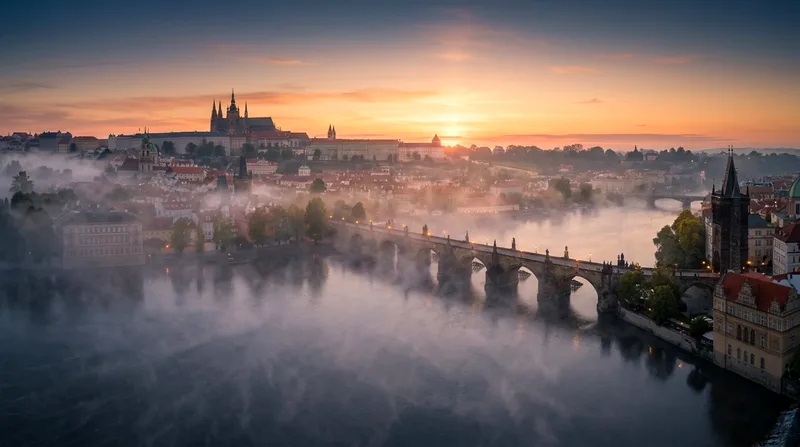
Charles IV is the single name worth remembering from Prague's medieval period. Crowned King of Bohemia in 1346 and later Holy Roman Emperor, he made Prague an imperial capital and used that use to build obsessively: Charles Bridge (started 1357), Charles University (founded 1348, the oldest university in Central Europe), and the core of St. Vitus Cathedral inside the Castle walls. Charles IV Prague projects are the reason the city has a Gothic skeleton under its later Baroque skin. Compare this to Vienna, which didn't reach comparable imperial status until the Habsburgs centuries later — Prague's golden age predates Vienna's by a long stretch, something Czechs will mention if you bring up the two cities in the same breath. Walking Charles Bridge at sunrise, before the crowds and the souvenir stalls fill in, is genuinely one of the better free things to do in the city, and it costs you nothing but an early alarm.
Habsburgs, Baroque and the Czech Revival
The three centuries between the Hussite Wars and the 19th century are where Prague's character gets complicated — a mix of religious rebellion, foreign rule, and a slow-burning cultural reawakening.
Hussites and the Defenestrations of Prague
Jan Hus, a reformist priest and rector at Charles University, challenged Catholic Church practices a century before Luther and was burned at the stake in 1415. His followers, the Hussites, didn't take it quietly — the First Defenestration of Prague in 1419, where a mob threw town councilors out of a New Town Hall window, triggered the Hussite Wars. A second, more famous defenestration in 1618, where Protestant nobles tossed Habsburg officials out of a Castle window, helped ignite the Thirty Years' War. Both events are a little absurd to explain to someone who's never heard of them, but they're central to how Czechs understand their own history of resisting external authority. Old Town Square still carries this tension in its monuments, including the large Jan Hus memorial unveiled in 1915.
Baroque churches and the National Revival
After 1526, Bohemia came under Habsburg Monarchy control, and after the Battle of White Mountain in 1620, the Habsburgs pushed hard re-Catholicization and German cultural dominance. The upside, if you can call it that, is the Baroque architecture it produced — St. Nicholas Church in the Lesser Town and much of the Castle district's current look date from this period. By the 19th century, a Czech National Revival pushed back against German-language dominance, reviving Czech language and culture; the National Museum (1818) and National Theatre (completed 1881, funded partly by public donations after a fire) are physical monuments to that movement. If you're comparing architectural density, Prague's Baroque layer is less overwhelming than Vienna's but arguably better preserved block-to-block than Budapest's, which lost more to 20th-century conflict.
20th Century: Republic, War and Communism
This is the era that shapes how Prague feels today — tense, resilient, and still processing what happened within living memory for some residents.
Czechoslovakia, Nazi occupation and the Jewish Quarter
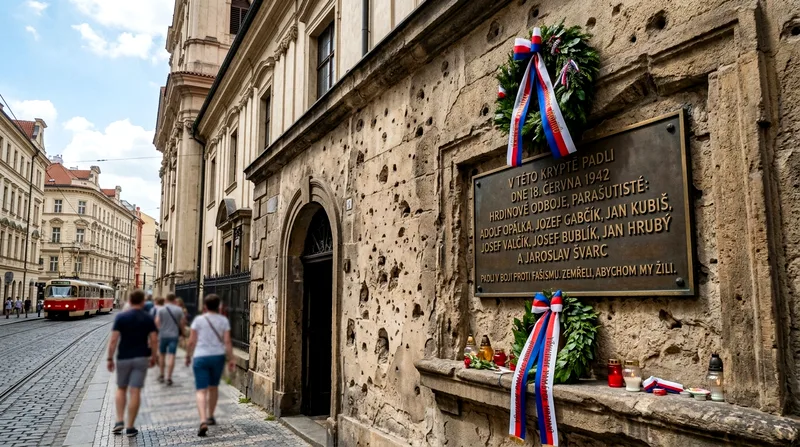
Czechoslovakia was founded in 1918 after the collapse of the Austro-Hungarian Empire, with Prague as its capital — a genuinely democratic, culturally ambitious First Republic. That ended in 1939 when Nazi Germany occupied the Czech lands, establishing the Protectorate of Bohemia and Moravia. The Jewish Quarter, Josefov, carries the heaviest weight from this period: its synagogues and the Old Jewish Cemetery survived partly because the Nazis, grimly, planned to preserve the area as a future "museum of an extinct race." That history is why the Jewish Quarter today functions as both a historic neighborhood and a memorial site — the Pinkas Synagogue alone lists tens of thousands of Czech Jewish victims of the Holocaust on its walls. It's a heavier visit than the Castle or Old Town Square, and worth pacing accordingly rather than rushing through on a combined ticket.
Prague Spring and the Velvet Revolution
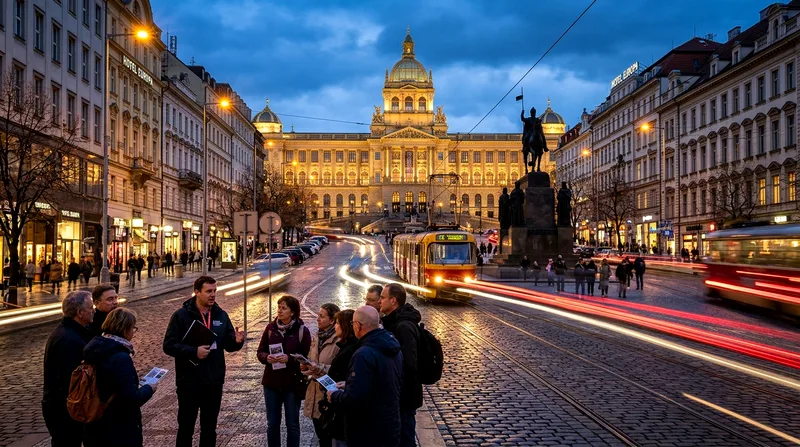
Communist rule began in 1948 after a Soviet-backed coup. The 1968 Prague Spring, a brief attempt at political liberalization under Alexander Dubček, ended when Warsaw Pact tanks rolled into the city that August — a scene still memorialized near the National Museum, where bullet damage from the invasion was deliberately left visible on the building's facade for decades. Two decades of harder-line rule followed before the Velvet Revolution of November 1989, a largely peaceful series of student-led protests centered on Wenceslas Square, forced the communist government to resign within weeks. Unlike Budapest's 1956 uprising, which was crushed by force, Prague's 1989 transition avoided major bloodshed — hence "velvet." Wenceslas Square today is more shopping street than shrine, which surprises some visitors, but the National Museum steps are still where locals gather for anniversaries.
Modern Prague and What It's Known For
Ask what Prague is known for today and you'll get a mix of answers: Gothic and Baroque architecture, beer culture, the Castle, puppet theater, and — increasingly — stag parties and overcrowded Old Town bars, which is the side of modern Prague I'd actively steer you away from if you're after the historic city rather than a pub crawl. The real draw is still the built environment: a historic center that functions as a working city rather than an open-air museum, unlike some over-restored European cores.
Prague today: UNESCO status and cultural identity
Prague's historic center was inscribed as a UNESCO World Heritage Site in 1992, covering roughly 866 hectares across the Castle district, Lesser Town, Old Town and New Town. That status doesn't freeze the city in amber — locals still live, work and renovate within it — but it does mean strict limits on new construction and facade changes in the core. Since joining the Czech Republic's democratic era after 1989, and the EU in 2004, Prague has become one of Europe's busiest city-break destinations, sometimes uncomfortably so around Charles Bridge and Old Town Square in peak summer months. If crowds bother you, Vyšehrad, the Lesser Town's quieter lanes, or an early morning Castle visit solve that problem better than fighting the Old Town Square crowds at midday.
Tours That Bring Prague's History to Life
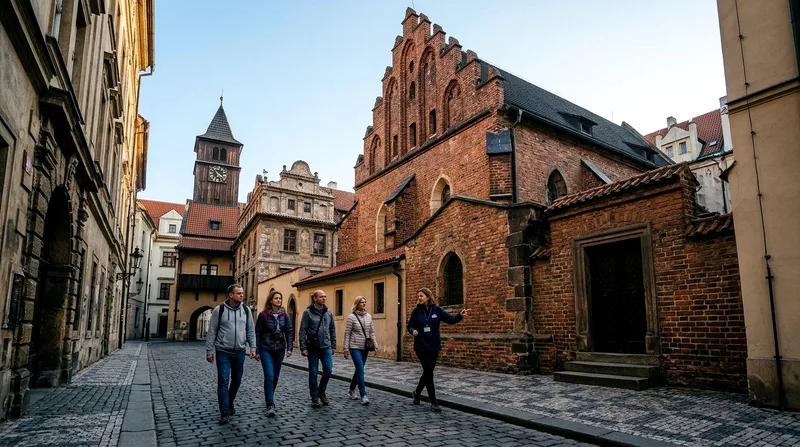
Self-guided wandering works for soaking up atmosphere, but Prague's history has enough layered, overlapping eras that a guide genuinely adds value — particularly for the Castle complex and Jewish Quarter, where unmarked details (a Romanesque wall fragment inside a Gothic structure, for instance) are easy to miss entirely on your own.
Castle, Old Town and Jewish Quarter tour types
For Prague Castle, look for a guided tour that includes St. Vitus Cathedral and the Old Royal Palace — entry to the cathedral's main nave is free, but the full Castle circuit (crown jewel exhibits excluded, since those aren't publicly displayed) usually requires a paid ticket, and a guide will explain which courtyard belongs to which century far faster than a self-paced audio guide. For Old Town Square, a walking tour covering the Astronomical Clock, Týn Church and the Jan Hus memorial typically runs 1.5 to 2 hours and pairs naturally with Charles Bridge. For the Jewish Quarter, a guided visit to the Old Jewish Cemetery and synagogues is worth prioritizing over a self-guided pass, given the historical weight and the fact that signage alone doesn't convey the Holocaust-era context well.
Communism-era and walking tour options
Communism-focused tours — sometimes combined with a visit to a Cold War-era nuclear bunker or the Museum of Communism near Wenceslas Square — are a solid add-on if the 20th century interests you more than medieval architecture. These run separately from Castle or Old Town tours and are worth booking as a distinct half-day rather than squeezing in in between. If you're building a broader Prague itinerary, pairing a half-day communism tour with a day trip to Kutna Hora (famous for its bone-filled Sedlec Ossuary, about an hour by train) or Cesky Krumlov gives you contrast — medieval small-town Bohemia versus Cold War-era Prague — without overloading a single day. Compare current prague history tours and combined ticket options before you book, since availability and group sizes vary by season.
Frequently asked questions
What is Prague best known for historically?
Prague is best known for being a well-preserved medieval and Baroque capital — specifically Prague Castle, Charles Bridge, and the Astronomical Clock in Old Town Square — plus its role as the stage for the 1989 Velvet Revolution, which ended communist rule peacefully. Its 14th-century golden age under Charles IV is the historical peak most visitors reference.
How old is Prague?
Prague Castle dates to around 880, making the settlement over 1,100 years old, though archaeological evidence suggests people lived along the Vltava river banks well before that. Vyšehrad, the second hilltop fort, has origin legends reaching into the same early Přemyslid period.
Who was Charles IV and why is he important to Prague?
Charles IV was King of Bohemia from 1346 and Holy Roman Emperor from 1355, and he turned Prague into an imperial capital. He commissioned Charles Bridge, founded Charles University in 1348 (the oldest university in Central Europe), and expanded St. Vitus Cathedral — projects that still define the city's medieval skyline.
Which historic sights should first-time visitors see in Prague?
Prioritize Prague Castle and St. Vitus Cathedral, Charles Bridge, Old Town Square with the Astronomical Clock, and the Jewish Quarter's synagogues and Old Jewish Cemetery. Add Wenceslas Square for the Velvet Revolution connection and Vyšehrad if you want fewer crowds with comparable river views.
How did Prague escape major destruction in World War II?
Prague wasn't a primary Allied bombing target the way Dresden or Munich were, and the limited bombing it did suffer in 1945 is widely attributed to navigational errors. The German garrison also surrendered relatively quickly after the May 1945 uprising, sparing the historic core from street-to-street fighting.