Discover the Prague Golem legend of Rabbi Loew, find every Golem-linked site in the Jewish Quarter and Old Town, and see which tours bring it to life.
The Prague Golem Legend Retold
Picture a damp cellar in 16th-century Josefov, a pile of river clay, and a rabbi whispering sacred letters over a human-shaped mound until it stirs. That's the core image behind the Prague Golem — a creature made of mud and animated by Hebrew incantations, built to protect Prague's Jewish community from persecution and, in the most repeated version, from blood libel accusations that were common across Central Europe at the time.
The story as most visitors hear it today wasn't written down in any 16th-century source. It took shape over centuries, gathering details, and was popularized most heavily in the 19th century by writers who reworked old Jewish folk motifs into a coherent narrative starring a specific historical figure. That's an important distinction, and I'd rather state it upfront than let a tour guide's dramatic delivery pass as settled fact.
Still, the legend is genuinely good, and it has staying power for a reason — it blends real anxieties (pogroms, forced expulsions, the precarious status of Jewish communities under imperial rule) with a fantasy of protection. That emotional truth is why the story survives better than a dry historical footnote would.
How the Golem Was Created
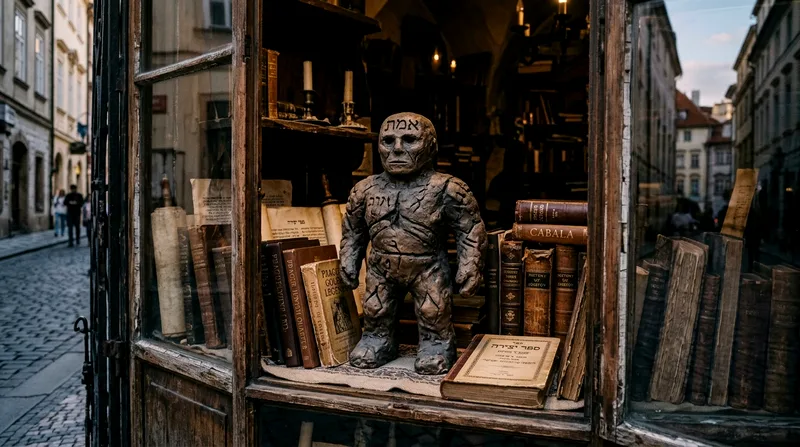
In the most common telling, the rabbi shaped the Golem from clay taken from the banks of the Vltava River, then brought it to life by placing a shem — a piece of paper inscribed with one of God's names, or sometimes the Hebrew word for truth, emet, written on its forehead — into its mouth or against its skin. The creature had no power of speech but enormous strength, and it served as a night watchman, patrolling Josefov's streets to protect residents from attackers and false accusations. Some versions have it growing uncontrollably large or violent when neglected, which adds a cautionary note about creations outgrowing their makers — a theme later echoed, not coincidentally, in Mary Shelley's Frankenstein and other golem-inspired fiction.
Why the Golem Was Put to Rest
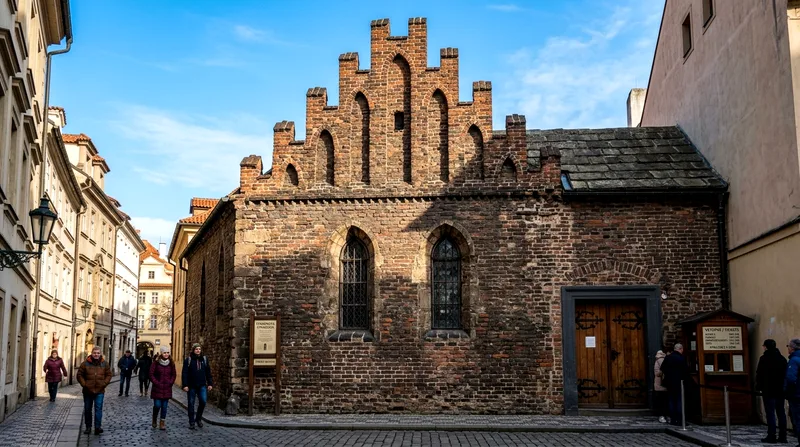
Every version agrees the Golem eventually had to be deactivated. The rabbi removed the shem, or erased the first letter of emet to leave met (meaning "death"), and the creature collapsed back into lifeless clay. The remains, the story goes, were carried up to the attic of the Old New Synagogue and sealed away — supposedly never to be reassembled unless the community faced mortal danger again. Nobody has produced the remains, naturally, but the attic itself is real, off-limits, and visible from the street below, which is exactly the kind of detail that keeps a legend alive rather than letting it fade into pure myth.
Who Was Rabbi Loew of Prague?
Rabbi Judah Loew ben Bezalel, usually called the Maharal (an acronym of "our teacher, Rabbi Loew"), was a real and significant figure in Prague's Jewish community, living roughly from 1520 to 1609. He wasn't a folk magician in his own lifetime — he was a respected scholar, philosopher, and chief rabbi whose writings on Talmudic interpretation, ethics, and Jewish philosophy are still studied today. He's buried in the Old Jewish Cemetery in Josefov, and that grave remains one of the most visited markers in the whole site.
The Historical Maharal
The Maharal led Prague's Jewish community during the reign of Emperor Rudolf II, a ruler famous for his fascination with alchemy, astrology, and the occult — which partly explains why later storytellers found it so easy to cast Rabbi Loew as a mystic. Historical records do show at least one documented meeting between Rabbi Loew and Rudolf II, likely about taxation or community protections, not sorcery. That single verified encounter became, centuries later, fertile ground for legend-builders to imagine deeper, stranger exchanges between rabbi and emperor.
How Fact Became Folklore
The direct link between Rabbi Loew and the Golem doesn't appear in print until the 1800s, roughly two centuries after his death — most notably through a collection of tales published in 1847 and later through Yudl Rosenberg's 1909 work, which many readers at the time mistook for a rediscovered ancient manuscript. Earlier golem folklore existed independently in Jewish mysticism, unconnected to any specific Prague rabbi. Rosenberg's version stuck, got exported into German Expressionist cinema in the 1910s and 20s, and from there became the "classic" Prague Golem story tourists hear now. If you want the honest version: Rabbi Loew's association with the Golem is a 19th-century literary invention grafted onto a real, respected 16th-century scholar.
Golem Sites to Visit in Prague
You can't verify the legend, but you can absolutely walk it, and that's the appeal of a Prague Golem itinerary — it's really a Jewish Quarter heritage walk with a ghost story threaded through it. Josefov is compact enough to cover on foot in half a day, and most Golem-linked points sit within a 10-minute walk of each other.
The Old New Synagogue and Old Jewish Cemetery are the two essential stops on any Prague Golem trail, each needing roughly 30-45 minutes.
Prague Golem sites compared: what you'll see and how long to allow
| Site | What You See | Time Needed | Access |
|---|---|---|---|
| Old New Synagogue | Gothic exterior, sealed attic (exterior view only) | 20-30 min | Interior needs Jewish Museum ticket; attic always closed |
| Old Jewish Cemetery | Rabbi Loew's grave, dense layered tombstones | 30-45 min | Ticketed entry via Jewish Museum |
| Jewish Town Hall | Hebrew clock, exterior architecture | 10-15 min | Viewed from street |
| Maisel Synagogue | Jewish history exhibition | 20-30 min | Ticketed, part of Jewish Museum circuit |
| Pinkas Synagogue | Holocaust memorial, inscribed names | 20-30 min | Ticketed, part of Jewish Museum circuit |
| Old Town Square | Astronomical Clock, general Old Town context | 15-20 min | Free, open square |
Typical visit durations; ticket inclusions and combined-entry rules for the Jewish Museum sites change periodically, so check current details before you go.
Old New Synagogue and Its Attic
The Old New Synagogue, built around 1270, is Europe's oldest active synagogue and the undisputed centerpiece of the Golem trail. Its steep Gothic gable and stepped roofline are instantly recognizable from Maiselova street, and the attic — where the Golem's remains are supposedly stored — is sealed and has never been formally opened for public viewing. That's part of the draw, honestly: a locked, inaccessible space generates more atmosphere than any open exhibit could. You can go inside the synagogue itself as part of a Jewish Museum ticket, but the attic stays off-limits, so don't expect to peek inside no matter which tour you book.
Old Jewish Cemetery and Town Hall Area
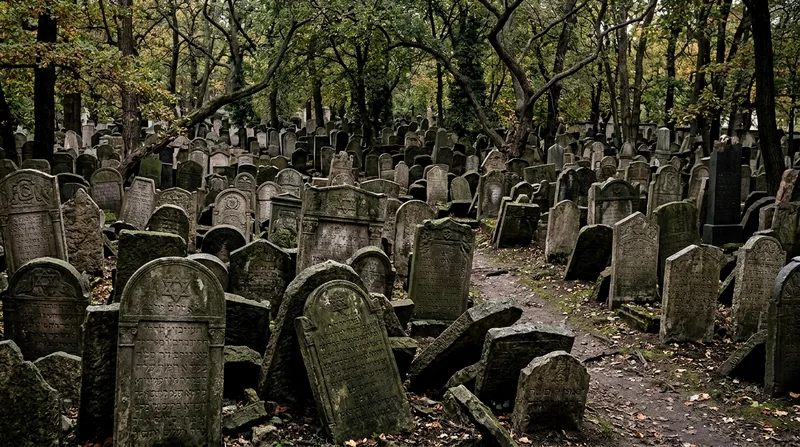
The Old Jewish Cemetery, used from the early 15th century until 1787, holds roughly 12,000 visible gravestones stacked in layers — burials there were so dense over the centuries that the ground was built up multiple times. Rabbi Loew's grave, marked with a distinctive tombstone, is one of the most-visited markers and is usually easy to find thanks to the small stones and paper notes visitors leave on it, a Jewish tradition of remembrance rather than a Golem-specific ritual. Nearby, the Jewish Town Hall with its Hebrew clock running counterclockwise, and the Maisel and Pinkas Synagogues, round out the Jewish Museum in Prague complex — worth combining with the Golem walk since they're steps apart and tell the wider, factual history of the community the Golem legend was born out of.
Golem Tours and Jewish Quarter Walks
A guided Prague Golem tour is worth booking if you want the folklore delivered with context rather than piecing it together from plaques, which are often brief or absent entirely at the sites themselves. Walking it alone is free and perfectly doable with a map, but you'll miss the connective tissue — why the cemetery is stacked so high, why the synagogue's gable looks the way it does, which details are 19th-century invention versus older tradition.
What Themed Tours Typically Cover
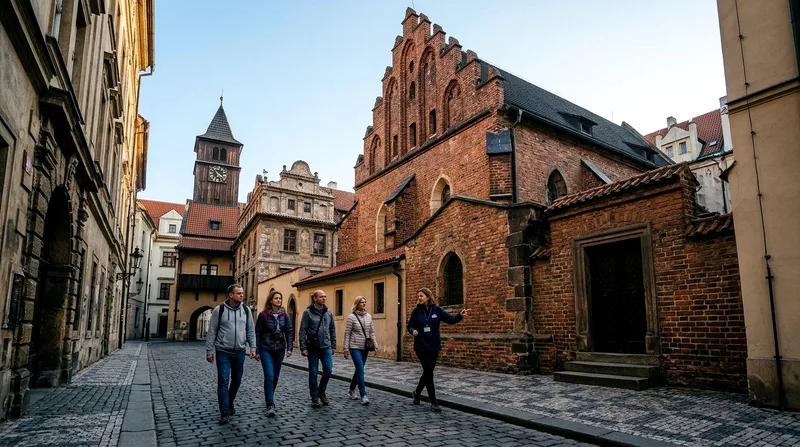
Most Jewish Quarter Golem-themed walks run around 1.5 to 2.5 hours, cover the exterior of the Old New Synagogue, the Old Jewish Cemetery, the Jewish Town Hall, and usually finish near Old Town Square, tying the Golem story into the wider history of Prague's Jewish community under Habsburg rule. Some run in the evening with lantern-lit storytelling, which suits the ghost-story mood better than a midday group with fifteen other tourists checking phones. Entry into the Old New Synagogue and cemetery typically requires a separate Jewish Museum ticket, so check whether your tour includes it or just covers the exteriors — this trips people up more than almost anything else on the walk. Compare current Jewish Quarter tour options and ticket inclusions before you book, since combined packages covering the synagogues, cemetery, and Golem storytelling vary by operator.
Golem Prague with Kids and Families
The Golem legend works well for families because it's a monster story with a moral center — a protector, not a villain — which makes it gentler than most European folklore involving giants or witches. Children old enough to follow a story (roughly age 7 and up) tend to enjoy it, especially with the visual payoff of the synagogue's sealed attic right there in front of them.
Making the Legend Fun for Children
Skip the cemetery's more solemn stretches with very young children and focus instead on the Golem narrative itself — the clay, the shem, the night patrols. Some family-oriented guides use props or simplified scripts aimed at kids, which helps more than a standard adult walking tour heavy on 19th-century publishing history. If you're traveling with children under 6, I'd honestly consider skipping a formal tour altogether and just pointing out the synagogue attic from the street, then letting them pick a Golem souvenir as the takeaway memory instead.
Golem Souvenirs and Pop Culture
Josefov's souvenir shops sell Golem figurines in every size and material, from small resin statues to carved wooden versions, alongside books and illustrated children's retellings. Quality varies enormously — some figures are genuinely well-made, others are generic mass-produced clay men with little connection to the actual legend, so look closely before buying. The Golem has also shown up in German Expressionist film (Paul Wegener's 1920 "The Golem: How He Came Into the World"), comics, and video games, so kids who've encountered golem characters elsewhere often arrive already curious rather than needing an introduction.
Planning Your Golem Trail
Give the Golem trail half a day at most — it's a compact walk, not a full-day excursion, and pairing it with the rest of Josefov's Jewish Museum sites makes far better use of your time than treating it as a standalone outing. Early morning or late afternoon avoids the heaviest tour groups around the Old New Synagogue exterior and the cemetery entrance.
One thing I'd avoid: paying extra for any tour or attraction that claims to show you the "actual Golem remains" or offers attic access. That attic is sealed; nobody shows it, and any operator implying otherwise is misrepresenting what's on offer. Also skip the wax-museum-style Golem exhibits scattered around the Old Town if you're short on time — they're forgettable compared to walking the real Josefov streets where the story is set.
Compare this to other legend-driven walks in the region — Cesky Krumlov has its own ghost and ancestral tales tied to the Rosenberg family, and Krakow's Kazimierz district carries a similar weight of Jewish heritage without the golem mythology attached. Prague's version has the advantage of a single, concentrated neighborhood where fact and folklore sit within a few hundred meters of each other, which is hard to match even in Vienna's Leopoldstadt or Budapest's Jewish Quarter.
Frequently asked questions
What is the legend of the Prague Golem?
The legend says a 16th-century rabbi shaped a human-like figure from river clay and brought it to life with a sacred word to protect Prague's Jewish community from persecution and false accusations. When it was no longer needed, the rabbi deactivated it and the remains were allegedly hidden in a synagogue attic, never to be reanimated unless the community faced mortal danger again.
Who was Rabbi Loew and did he really create the Golem?
Rabbi Judah Loew ben Bezalel, the Maharal, was a real and respected 16th-century scholar and chief rabbi of Prague who died in 1609. The Golem story wasn't attached to him until the 1800s, roughly two centuries after his death, through popular literature — there's no historical evidence he created anything of the kind.
Where is the Golem said to be buried in Prague?
Folklore places the Golem's remains in the attic of the Old New Synagogue in Josefov. The attic is real and sealed off from the public, which is exactly why the story has persisted — nobody has been able to disprove it by looking inside.
Can you visit the Old New Synagogue attic?
No. The attic has never been opened for public tours or exhibitions, and no legitimate tour offers entry to it. You can view the synagogue's exterior and Gothic gable from the street, and enter the main prayer hall with a Jewish Museum ticket, but the attic stays closed.
Is the Prague Golem story suitable for children?
Yes, generally — it's a protector story rather than a horror story, and works well for children around age 7 and up. For younger kids, stick to a simplified retelling and the visual of the sealed attic rather than a full historical walking tour, which leans heavily on dates and publishing history.