Compare Prague black light theatre shows by style and child suitability, see what tickets include, and learn how to book safely for a language-free night out.
What Is Prague Black Light Theatre?
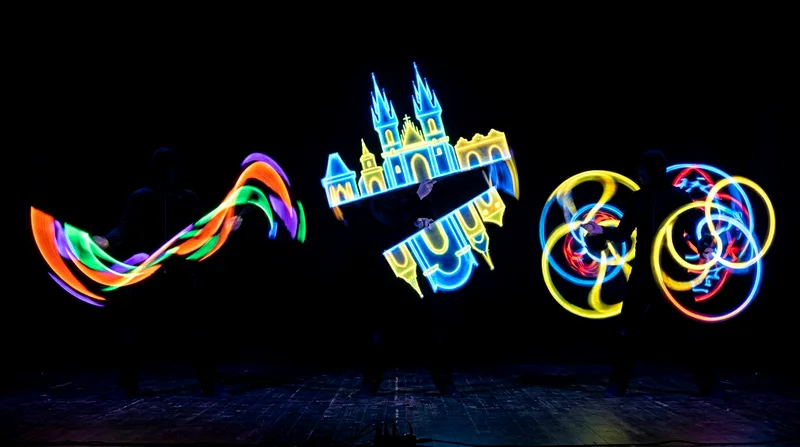
Prague black light theatre uses a simple optical trick: performers dressed in black move against a black backdrop under ultraviolet light, while fluorescent props, costumes, and painted elements seem to float and glow on their own. The effect was developed in Prague in the 1960s, most famously associated with director Jiří Srnec, whose work helped define the genre internationally. Czechs still consider it a homegrown art form, not a tourist gimmick retrofitted for visitors — though plenty of theatres near Old Town and New Town now program shows specifically with foreign audiences in mind.
What makes it worth your evening isn't novelty alone. A well-staged black light show blends mime, dance, puppetry, and sometimes acrobatics into something closer to visual theatre than a magic trick. The better productions have real narrative structure — a love story, a surreal dream sequence, a comic misadventure — told entirely through movement and light. The weaker ones lean on the UV gimmick without much choreography behind it, which is where comparison shopping actually matters.
How the illusion works
The stage is lit almost entirely by ultraviolet lamps. Performers wear black velvet-type suits that absorb UV light and effectively disappear against the black curtains and floor. Objects painted with fluorescent pigment — ribbons, geometric shapes, skeletal puppet frames — reflect the UV light brightly, so an audience sees glowing shapes moving with no visible human form attached. Skilled performers can make a glowing ball appear to bounce by itself, or make a puppet seem fully autonomous, by keeping their blacked-out bodies perfectly still or perfectly hidden behind the object's silhouette. It's a low-tech effect, decades old, but still startlingly convincing live in a dark 300-to-600-seat theatre.
Why it suits non-Czech speakers
There's no spoken dialogue in most black light productions — storytelling happens through movement, music, and visual gags, so you lose nothing by not speaking Czech. This is a real practical advantage over Czech-language theatre or opera with surtitles you can't read quickly enough. If you've ever sat through a show in Vienna or Budapest wishing you'd brushed up on German or Hungarian first, black light theatre removes that anxiety entirely. It's one reason the format has become a reliable recommendation for international visitors who want an evening of Czech culture without homework beforehand.
What Black Light Theatre Tickets Include
A standard ticket covers one seat for a single performance, typically running 60 to 90 minutes without an intermission, though some productions split into two acts with a short break. That's genuinely the core product — don't expect meal packages or transport bundled in unless a specific listing says so explicitly on the theatre's own site.
Where tickets differ is mostly about where you sit and how close you want to be to the stage. Front-row seats put you near enough to see the mechanics of the illusion — the faint outline of a performer's movement, the seams of the UV suits — which some travellers find breaks the spell rather than enhancing it. Mid-theatre seats, roughly rows 5 through 12 depending on the venue, tend to give the cleanest version of the visual effect because you're far enough back that the glowing shapes read as fully detached from any human form.
Seating categories and what changes
Most Prague theatres sell tickets in two or three price tiers — often labelled simply as category I, II, and III, or front/middle/rear stalls. The price difference is modest compared to London or Vienna theatre pricing, and the actual visual experience doesn't degrade much even in the cheaper rear seats, since the whole point of the effect is designed to read clearly from a distance. Balcony seating, where offered, can actually be a good value choice for black light shows specifically, because the elevated angle sometimes makes the floating-prop illusion even more convincing. Always check the seating chart on the official booking page before you buy — some older Prague theatre buildings have tight sightlines or support pillars in certain side sections.
Typical exclusions and extras
Programmes or souvenir booklets are usually sold separately in the lobby, not included in ticket price. Cloakroom use is often free or low-cost but isn't bundled into the ticket cost itself. Photography and filming during the performance are almost universally banned, partly to protect the UV effect for other audience members — a flash or phone light genuinely ruins the illusion for everyone nearby, so don't try it. Some venues offer combined tickets with dinner at a nearby restaurant; treat these as a convenience bundle rather than a discount, and compare the total against booking dinner and the show separately.
Prague Black Light Shows Compared
Not all black light theatre in Prague is interchangeable, and this is where most ticket guides go too vague to be useful. Laterna Magika, based at the National Theatre's New Stage, is the most internationally recognized name and leans heavily into multimedia — combining black light technique with film projection, dance, and a more avant-garde, sometimes abstract tone. It's the closest thing to a "serious theatre" experience in this genre, and it suits adults and older teens more than small children, since the pacing is deliberate rather than constantly eventful.
Image Theatre, running productions in the Old Town area for decades, tends toward a lighter, more comic and fairy-tale register, with clearer storylines and more visual humor — generally a safer bet for mixed-age family groups. Ta Fantastika, known for staging black light versions of well-known stories (including Aladdin-style and fairy-tale adaptations), sits somewhere between the two: accessible and family-friendly, but with more polished choreography and spectacle than Image Theatre's smaller-scale shows.
Ta Fantastika and Image Theatre suit families best, while Laterna Magika rewards adults who want a more abstract, multimedia performance.
Prague black light theatre shows compared by style and child suitability
| Show/Venue | Style | Best For | Typical Duration | Dialogue |
|---|---|---|---|---|
| Laterna Magika | Multimedia, abstract, film-and-dance hybrid | Adults, teens, date nights | approx. 70-90 min | None |
| Ta Fantastika | Fairy-tale narrative, polished spectacle | Families with kids 6+, first-timers | approx. 60-75 min | None |
| Image Theatre | Comic, visual-gag led, smaller scale | Mixed-age families, casual evening | approx. 60-70 min | None |
Durations and current repertoire vary by production and season; confirm exact running time and show title on the official theatre website before booking.
Show style: storytelling, music or visual spectacle
If you want a show that still has narrative throughline — a recognizable story with a beginning, middle and end — Ta Fantastika's fairy-tale-based productions are usually the safest choice. If you're drawn more to abstract visual art and live music than plot, Laterna Magika's multimedia approach rewards patience and delivers something closer to a dance-and-film hybrid. Image Theatre sits in between, often using a loose comic narrative as a frame for a sequence of visual gags and illusions rather than a tightly plotted story. None of these is objectively "better" — it depends whether you came for spectacle or for story.
Child suitability and age guidance
For black light theatre Prague shows aimed at families, Image Theatre and Ta Fantastika's lighter productions generally work well for children from about age 6 upward — young enough kids can follow visual comedy without needing subtitles or dialogue, but very young children (under 4 or 5) may find the darkness and UV lighting disorienting or simply get bored during slower stretches. Laterna Magika's more abstract, adult-oriented staging is a harder sell for kids under 10 or 11; it's genuinely better suited to adults and teenagers who can sit with ambiguity. Always check the specific production listed for your date — theatres rotate repertoire, and not every show in a venue's season is equally child-friendly.
Where and How to Buy Tickets
Buy directly from the theatre's own website whenever that option exists — it's the only way to be certain about seating category, accurate show duration, and whether a specific performance has been altered or cancelled. Prague's black light venues cluster conveniently around Old Town and New Town, an easy walk or short tram ride from most central hotels, so this isn't an experience that requires a special trip out to the suburbs the way, say, a day trip to Kutna Hora or Cesky Krumlov would.
Official box offices and websites
Each theatre — Laterna Magika, Image Theatre, Ta Fantastika — maintains its own official box office, either at the venue itself or through its own website, and this is the first place to check for current dates, running times, and seating availability. Many city tourist information points near Old Town Square also sell authorized tickets at face value, which is a reasonable backup if you prefer to book in person rather than online. Confirm performance length and any intermission details on the official page before you commit, since this can shift slightly between productions in the same venue.
Avoiding street sellers and unofficial resellers
Around Old Town Square and the main tourist routes, people in costume or holding clipboards sell theatre and concert tickets at a markup, sometimes substantial. It's not illegal, but it's a poor way to buy — you often can't verify the seating category, and refund or exchange options are murky to nonexistent if your plans change. The same caution applies to third-party resale sites that aren't the theatre's own domain or a recognized local box office; if a price looks unusually high compared to what the venue publishes, walk away and book directly instead.
Is It Worth It? By Traveller Type
Whether a black light show earns its place in a short Prague itinerary depends more on your travel style than on the genre itself. It's an easy, low-commitment evening — no reservations months out, no dress code, and venues are centrally located enough that you can pair it with dinner beforehand without logistics eating your night.
Families, couples and solo travelers
Families get the clearest win here: it's one of few evening activities in Prague that keeps kids engaged without needing them to read or follow spoken plot, making it a genuine alternative to an early hotel-room night. Couples looking for something different from the standard dinner-and-walk routine will likely enjoy Laterna Magika's more atmospheric, date-night tone. Solo travelers sometimes feel self-conscious booking a single seat to a "show," but black light theatre is actually one of the easier solo bookings in the city — single seats are common, and nobody expects conversation during a performance anyway.
First-time visitors with limited time
If you only have two or three nights in Prague and are weighing a black light show against, say, a river cruise or a trip to see the Astronomical Clock illuminated at night, the theatre option gives you a full 60-to-90-minute indoor activity regardless of weather — a real advantage over outdoor options in Prague's unpredictable spring and autumn evenings. It's less essential, frankly, than simply walking Old Town after dark or catching a view from Petřín, so treat it as a strong second-night choice rather than the one unmissable booking, unless the genre specifically appeals to you.
Frequently asked questions
What is black light theatre in Prague?
It's a Prague-originated performance style where black-clad performers work invisibly under ultraviolet light while fluorescent props and costumes appear to move on their own. Developed in the 1960s and linked to director Jiří Srnec, it blends mime, puppetry, and dance into a wordless visual show, typically 60 to 90 minutes long.
Is black light theatre suitable for children?
Many productions are, especially lighter, comic shows at Image Theatre and fairy-tale adaptations at Ta Fantastika, generally suited to children from around age 6. Younger children can find the dark auditorium and UV lighting unsettling or lose interest during slower scenes, so check the specific show description rather than assuming every production is equally child-friendly.
Do I need to speak Czech to enjoy a black light show?
No — this is one of the main reasons the genre appeals to international visitors. Nearly all black light theatre is performed without spoken dialogue, relying on movement, music, and visual storytelling, so there's nothing to translate or subtitle.
Where should I buy black light theatre tickets in Prague?
Book directly through the theatre's own website — Laterna Magika, Image Theatre, or Ta Fantastika — or through an official box office or recognized tourist information point. Avoid street vendors near Old Town Square and third-party resale sites, since prices there are often inflated and refund policies unclear.
How far ahead should I book a Prague black light theatre show?
There's no universally published lead time, since availability depends on the season and specific production, but booking a few days to a week ahead is a reasonable habit for peak travel months. Check the official site for the exact date you want, since repertoire and showtimes rotate and aren't fixed year-round.