A 5-day Prague itinerary at a gentle pace: Vysehrad, local lanes, a cross-border day trip, plus where to stay for couples and seniors.
A Prague Itinerary 5 Days Long, Built for a Slower Pace
This Prague itinerary for 5 days is for people who'd rather see four things properly than eight things badly. It suits couples who want long lunches and river views as much as the photo stops, and it suits senior travelers who'd prefer fewer cobblestone sprints and more benches along the way. If you're coming from Vienna or Budapest and expecting a similarly walkable, café-heavy city, Prague delivers that — but its hills (the Castle district especially) reward a slower rhythm more than a checklist approach.
The plan below covers Prague Castle, Charles Bridge and Old Town Square, because skipping them would be a mistake — they're famous for good reason. But it also builds in Vysehrad, a quieter fortress with arguably better river views and a fraction of the crowds, plus time in local neighbourhoods where nobody's selling trdelník. Day 4 steps outside Prague entirely for a cross-border day trip, and Day 5 slows right down before you leave. Each day has two or three main stops, built-in rest breaks, and one experience worth booking ahead — described in general terms, since availability and operators change.
Day 1: Castle District at a Gentle Pace
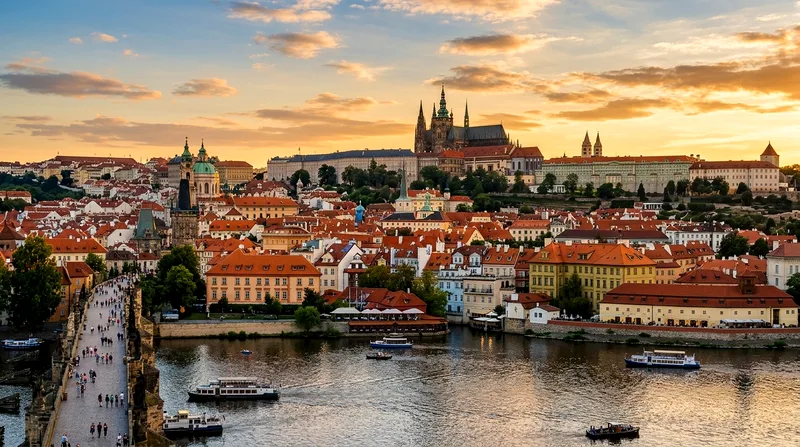
Prague Castle is the obvious start, but it's also the day most itineraries get wrong by trying to see the whole castle complex, Golden Lane, St. Vitus Cathedral and Lesser Town in one breathless sweep. Don't. The castle sits on a hill, and the approach from Malostranská metro station involves a steady climb that catches people off guard — especially after a long flight the day before.
Each day in this relaxed Prague itinerary focuses on one or two areas, so you're never crossing the city twice in a single afternoon.
Prague itinerary 5 days: area, pace and main sights by day
| Day | Main Area | Pace | Key Sights |
|---|---|---|---|
| Day 1 | Castle District & Lesser Town | Moderate (one hill climb) | Prague Castle, St. Vitus Cathedral, Kampa Island |
| Day 2 | Old Town | Moderate (uneven cobbles) | Old Town Square, Charles Bridge, Ungelt courtyard |
| Day 3 | Vysehrad & Vinohrady | Easy (flat fortress walk) | Vysehrad ramparts, cemetery, local cafés |
| Day 4 | Day trip (Dresden or Kutná Hora) | Varies by destination | Frauenkirche or Sedlec Ossuary |
| Day 5 | Petřín Hill & riverside | Easy (funicular available) | Petřín gardens, Náplavka embankment |
Typical pacing; adjust walking distances based on mobility and season, and always check current transport schedules before you travel.
Morning and afternoon: Prague Castle and Lesser Town
Start around 9:30am, once the earliest tour groups have thinned slightly. Take the tram or metro to Malostranská rather than walking up from the river — save your legs for inside the complex. Budget two to two and a half hours for the castle grounds, St. Vitus Cathedral (free to view from the nave, paid tickets for the full interior route) and Golden Lane. Then descend slowly into Lesser Town (Malá Strana) for lunch — this neighbourhood has fewer tourist-menu restaurants than Old Town and a noticeably calmer pace. Sit somewhere with outdoor seating near Kampa Island if the weather allows; it's one of the few spots in central Prague where you can hear water over traffic.
If it's raining or you're simply tired by early afternoon, skip Golden Lane (it's the most crowded, least essential part of the castle) and head straight to the Lobkowicz Palace museum inside the castle walls instead — it's smaller, less crowded, and you can sit through most of it.
Evening: relaxed dinner and river views
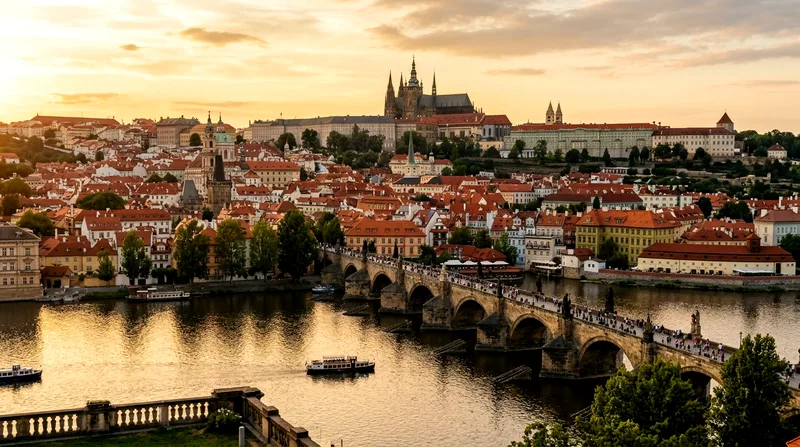
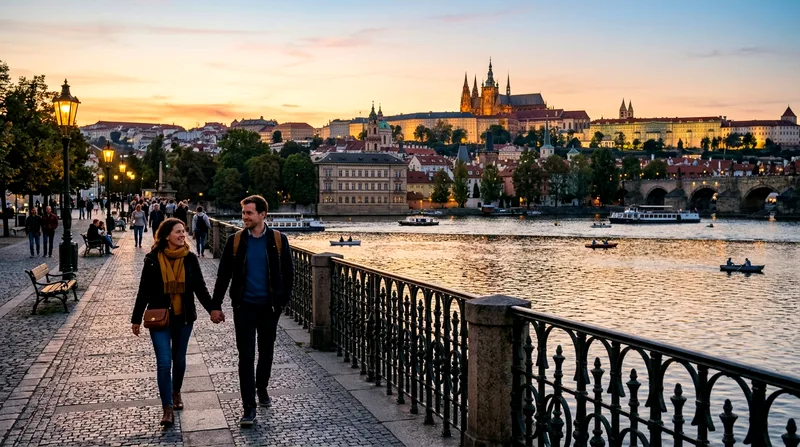
Walk down toward the river for sunset — the embankment near Charles Bridge on the Lesser Town side gives you the castle lit up behind you without needing to fight for a bridge-top spot. This is the evening to book a sunset river cruise if you want one; a one-hour boat tour along the Vltava is a low-effort way to see the castle, bridges and riverfront without any walking, and it's genuinely restful after a day on your feet. Compare current boat tours and prices before you book, since departure times shift seasonally. Dinner afterward in Lesser Town or just over the bridge keeps the evening short and the walk back to your hotel manageable.
Day 2: Old Town and Quiet Lanes
Old Town Square and Charles Bridge are non-negotiable — they're what most people picture when they think of Prague. The trick is timing. Both get swamped by midday, particularly between 11am and 3pm when day-trip tour buses arrive.
Morning and afternoon: Old Town Square and Charles Bridge
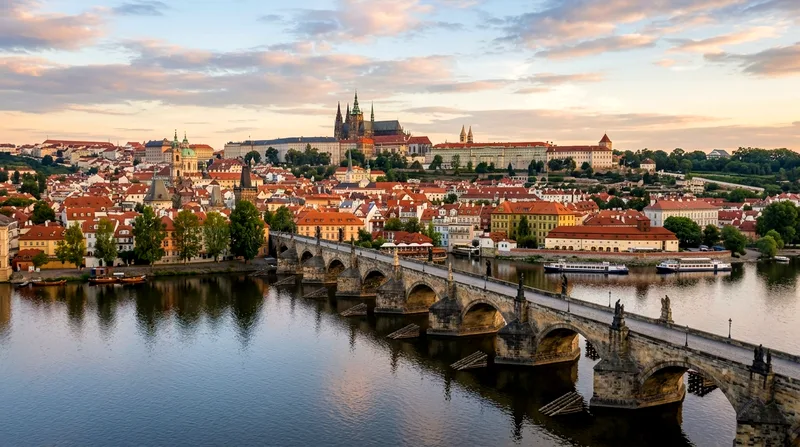
Arrive at Old Town Square by 9am if you can manage it — the Astronomical Clock crowd is thin, the cafés are setting up, and photos are actually possible without three strangers in them. Spend 45 minutes here, then walk to Charles Bridge before 10am. Crossing it early means you can actually look at the baroque statues lining the bridge rather than just shuffling forward. After crossing, don't follow the main tourist flow back immediately — instead, wander into the quieter lanes east of the square, toward the Ungelt courtyard or around St. Agnes Convent, where the streets empty out noticeably within two or three blocks of the main square. This contrast is sharper in Prague than in, say, Krakow's Main Square, where the old town is more compact and harder to "escape" so easily.
Evening: Old Town stroll and dinner
After an afternoon rest back at your hotel (genuinely build this in — Old Town's cobblestones are uneven and tiring over a full day), return for an early evening stroll when the square has a different character: lit windows, fewer tour flags, street musicians instead of megaphones. Dinner in Old Town itself is often overpriced and mediocre — a common complaint, and a fair one. Walk ten minutes toward the Náměstí Republiky area instead, where prices drop and the food quality tends to improve. This is also a good evening to pre-book a classical concert in one of Old Town's churches, a low-key, seated evening activity that pairs well with tired legs.
Day 3: Vysehrad and Local Neighbourhoods
This is the day that separates a relaxed Prague itinerary from a rushed one. Vysehrad, a hilltop fortress south of the centre, gets a fraction of Prague Castle's visitors despite having comparable river views and a genuinely atmospheric cemetery where composers Dvořák and Smetana are buried.
Morning and afternoon: Vysehrad fortress and cemetery
Take the metro (red line C) directly to Vyšehrad station — it's a five-minute walk from there to the fortress gates, flat and easy, unlike the climb to Prague Castle. Plan two to three hours here: the Basilica of St. Peter and St. Paul, the cemetery (Vyšehrad Cemetery, entry is free and unhurried), and the ramparts overlooking a bend in the Vltava that's arguably more photogenic than the view from Charles Bridge, simply because there's nobody else trying to get the same shot. There are benches along the walls — use them. This is one of the few spots in central Prague where sitting still for twenty minutes feels like the point, not a compromise.
Evening: café and pub in a local district
From Vysehrad, head into Vinohrady or Žižkov — two residential districts with leafy streets, neighbourhood pubs, and none of the souvenir-shop density of the centre. Vinohrady in particular has a slower, almost suburban feel, with good small restaurants around Náměstí Míru. This is a good night for an unstructured dinner rather than a booked activity — ask your hotel for one current recommendation rather than relying on outdated lists, since small neighbourhood places turn over fairly often.
Day 4: Cross-Border Day Trip from Prague
A Prague day trip itinerary doesn't need to mean Český Krumlov, even though it's the most-booked option. Český Krumlov is beautiful but it's a three-hour round-trip minimum each way by bus or train, which eats most of your day in transit — hard going if you're pacing yourself. Kutná Hora is closer, about an hour each way by train, and gives you the Sedlec Ossuary and a genuinely interesting silver-mining history without the long haul.
Morning and afternoon: choosing a destination and pacing the day
For a true cross-border day trip, Dresden is the most realistic option from Prague — roughly two hours each way by train, crossing into Germany through the Elbe valley. It gives you a different architectural rhythm entirely: baroque Saxon rebuilding rather than Bohemian Gothic, and the Frauenkirche and Zwinger palace complex are both manageable on foot without much backtracking. Leave by mid-morning (9am trains give you a full afternoon), and don't try to see everything — pick the old town core and one museum, then stop. Travelers often try to combine Dresden with a rushed Meissen side trip; skip that unless you're staying overnight, it's one push too far for a day trip pace. If a long train journey doesn't appeal, Kutná Hora as a half-day option is the gentler choice and gets you back to Prague by mid-afternoon.
Evening: easy return and light dinner
Whichever you choose, treat the evening as recovery time. Trains back into Prague's main station arrive within walking or short tram distance of most central hotels. Keep dinner simple and nearby — this isn't the night for a restaurant that requires a reservation and a tram transfer. A bowl of soup and an early night serves you better than another ambitious outing.
Day 5: Slow Riverside Farewell Day
The last day of any relaxed Prague itinerary should have no hard deadlines beyond your actual departure. This is where the "5 days in Prague" structure pays off — you're not trying to squeeze in a missed sight, because you've already seen the essentials at a reasonable pace.
Morning and afternoon: gardens, market or museum of choice
Petřín Hill is the natural choice for a gentle morning — a funicular (covered by standard public transport tickets) takes you up without the climb, and the gardens at the top are quiet even in high season, with good benches and skyline views that rival the castle lookout. Alternatively, if gardens aren't your thing, a slow morning at the Naprstek Museum or a wander through Havelská Market for produce and small souvenirs works just as well. Avoid trying to fit in one more "major" sight like the Jewish Quarter synagogues on this day unless you genuinely have the energy — it's a dense, emotionally heavy visit that deserves its own unhurried half-day, not a tacked-on hour.
Evening: farewell dinner
Book a farewell dinner somewhere with a river view rather than in the main square — restaurants along the Náplavka embankment on the Vltava's right bank offer a calmer, more local evening, especially if you arrive before 7pm. If the weather's decent, a short riverside walk after dinner is a better closing note than another attraction ticked off a list.
Getting Around, Where to Stay, Optional Extras
Prague's public transport — metro, trams and buses on one ticket system — is reliable and makes a slower pace genuinely easy to manage, more so than in Budapest, where routes are less intuitive for first-time visitors. A 24-hour or 72-hour transport pass covers nearly everything in this itinerary, including the Petřín funicular.
Getting around and where to base yourself
For this pace, base yourself in Lesser Town, Old Town's quieter eastern edge, or Vinohrady. Lesser Town puts you closest to the castle and river but has steeper streets; Vinohrady is flatter, more residential, and a short tram ride from everything else — often the better choice for senior travelers prioritizing easy mornings over being "in the thick of it." Avoid booking anything directly on Old Town Square itself; noise from evening crowds is a genuine, recurring complaint, and you'll pay a premium for it. The metro's red and green lines handle most of this itinerary; trams fill the gaps, particularly up toward the castle.
Optional bookable experiences
Beyond the sunset river cruise on Day 1, consider a guided walking tour focused specifically on Vysehrad or Vinohrady if you want context without self-navigating — these smaller, neighbourhood-specific tours tend to be less rushed than big Old Town walking tours with 20-plus people. A half-day Kutná Hora or Dresden trip is worth booking as an organised tour rather than DIY train travel if you'd rather not manage timetables yourself. Check current prices and availability for any of these when you're ready to book, since schedules and group sizes vary by season.
Frequently asked questions
Is 5 days in Prague too long or just right?
For a relaxed pace with rest breaks built in, 5 days is close to ideal — enough time for the main icons plus Vysehrad, local neighbourhoods and a day trip without rushing. Three days forces you to cut either Vysehrad or the day trip; a full week lets you add Dresden and Český Krumlov both, or simply slow down further.
What is the best area to stay in Prague for seniors?
Vinohrady is generally the easiest choice — flat streets, good tram connections, and a quieter residential feel compared to Old Town or the steep lanes of Lesser Town. It's a five- to ten-minute tram ride from the centre, which keeps you close without the noise or hills.
Is Prague walkable for people who prefer a slower pace?
Yes, with planning. Central Prague is compact, but cobblestones are uneven and the Castle district involves a real incline. Pair walking with the metro and trams rather than attempting everything on foot, and build in café stops every couple of hours rather than pushing through.
Which cross-border day trip from Prague is easiest?
Dresden is the most practical true cross-border option, about two hours each way by direct train, with a walkable old town on arrival. If an international trip feels like too much, Kutná Hora (around one hour by train, still within Czechia) offers a similar change of pace with less travel time.
How can I extend this itinerary to a week in Prague?
Add a second day trip (Český Krumlov works well as a full-day or overnight add-on), dedicate a half-day to the Jewish Quarter's synagogues and cemetery, and add one more unstructured day in a neighbourhood like Žižkov or Holešovice. Spread the extra days between sightseeing and genuine downtime rather than adding more stops per day.